
HELWAN SOUTH
3 x 650 MWe
GAS-FIRED STEAM POWER PROJECT


Arab Republic of Egypt
Ministry of Electricity and Energy
Egyptian Electricity Holding Company
Upper Egypt Electricity Production Company
HELWAN SOUTH 3 x 650 MWe GAS-FIRED
STEAM POWER PROJECT
Environmental and Social
Impact Assessment
EXECUTIVE SUMMARY
FINAL REPORT
Volume – II(A)
May 2011
Project No. 1573
Submitted by:
Engineering Consultants Group (ECG)
Bldg. 2, Block 10, El-Safarat District
Nasr City 11765, Cairo, Egypt.
P.O. Box: 1167. Cairo 11511, Egypt.
HELWAN SOUTH 3 x 650 MWe GAS-FIRED
STEAM POWER PROJECT
Environmental and Social
Impact Assessment
EXECUTIVE SUMMARY
1. INTRODUCTION
1.1 Background
1.2 Project Overview
2. THE ENVIRONMENTAL AND SOCIAL IMPACT ASSESSMENT
2.1 Contributors to the EIA Report
2.2 Scope of the EIA Report
Legal and Administrative Framework
3. GENERAL SETTING OF THE SITE:
DESCRIPTION OF THE ENVIRONMENT
4. PROJECT DESCRIPTION
4.1 Overview of the Power Plant
4.2 Process Description
4.3 Operational Releases from the Power Plant
5. ANALYSIS OF ALTERNATIVES
5.1 Current Situation (“No Action” Option)
5.2 Alternative Technologies and Fuels
5.3 Power Plant Design
5.4 Alternative Sites
6. KEY FINDINGS OF THE ENVIRONMENTAL AND
SOCIAL IMPACT ASSESSMENT
6.1 Introduction
6.2 Air Quality
6.3 Aquatic Environment
6.4 Noise Impacts
6.5 Flora and Fauna
6.6 Land Use, Landscape and Visual Impacts
6.7 Soils, Geology and Hydrology
6.8 Traffic
6.9 Socio-economics and Socio-cultural effects
6.10 Archaeology, Historic and Cultural Heritage
6.11 Natural Disaster Risks
6.12 Major Accident Hazards
6.13 Solid and Hazardous Waste Management
6.14 Occupational Health and Safety
6.15 Associated Infrastructure
7. ENVIRONMENTAL MITIGATION AND MONITORING:
THE ENVIRONMENTAL AND SOCIAL MANAGEMENT PLAN (ESMP)
7.1 Enhancement and Mitigation Plan
7.2 Monitoring Program
8. PUBLIC CONSULTATION AND DISCLOSURE
9. RESPONSIBILITIES AND INSTITUTIONAL
9.1 Environmental Management Organization
9.2 Environmental Training
9.3 Occupational Health and Safety
9.4 Emergency Procedure and Accident Response
10. IMPLEMENTATION SCHEDULE AND REPORTING
11. CONCLUSIONS
12. REFERENCES AND CONTACTS
ABBREVIATIONS AND ACRONYMS
BOD Biochemical Oxygen Demand
BPIP Building Profile Input Program
CAA Competent Administrative Authority
CAPMAS Central Agency for Public Mobilization and Statistics
COD Chemical Oxygen Demand
CWDS Circulating Water Discharge Structure
DCS Distributed Control System
DO Dissolved Oxygen
DS Dissolved Solids
EAAQLs Egyptian Ambient Air Quality Limits
EEA Egyptian Electricity Authority
EEAA Egyptian Environmental Affairs Agency
EEHC Egyptian Electricity Holding Company
ED Environmental Department
EGAS Egyptian Natural Gas Holding Company
EGSMA Egyptian Geological Survey and Mining Authority
EHS Environmental Health and Safety
EIA Environmental Impact Assessment
EMS Environmental Management Staff
ENIT Egyptian National Institute of Transport
ESIA Environmental and Social Impact Assessment
ESMP Environmental and Social Management Plan
EUPS Egyptian Unified Power System
FHWA Federal Highway Administration, (US)
FM Finance Manager
GARBLT General Authority for Roads, Bridges and Land Transport
GASCO Egyptian Natural Gas Company
GEP Good Engineering Practice
GDP Gross Domestic Production
GIS Gas-Insulated Switchgear
GT Gas Turbine
HCM Highway Capacity Manual
HFO Heavy Fuel Oil
HGVs Heavy Goods Vehicles
HPP Helwan South Power Plant
HSE Health, Safety and Environment
LFO Light Fuel Oil
LOS Level of Service
MWRI Ministry of Water Resources & Irrigation
MSDSs Material Safety Data Sheets
MWe Mega-Watt electrical
NFRA National Fire Protection Authority
NRIAG National Research Institute for Astronomy and Geophysic
OSHA Occupational Safety and Health Administration
PCBs Polychlorinated Biphenyls
PCDA Public Consultation and Disclosure Activities
pcph passenger car per hour
PMU Project Management Unit
PRS Pressure Reducing Station
RIGW Research Institute for Ground Water
SFD Social Fund for Development
SS Suspended Solids
STG Steam Turbine Generator
TDS Total Dissolved Solids
TOC Total Organic Carbon
TSS Total Suspended Solids
TWA Time-Weighted Average
UEEPC Upper Egypt Electricity Production Company
vph vehicle per hour
List of Tables
|
Table 1 |
: |
Potential World Bank Environmental Safeguard Policies and Helwan South Power Project Triggerability |
|
Table 2 |
: |
Key Findings of the Consideration of Alternative Sites |
|
Table 3 |
: |
Environmental, Health and Safety Issues Relating to Construction and Operation of Helwan South Power Project |
|
Table 4 |
: |
Environmental Impacts and Environmental Guidelines |
|
Table 5 |
: |
Institutional Arrangements for Helwan South Power Project |
|
Table 6 |
: |
Construction Impact Mitigation, Monitoring and Management Measures |
|
Table 7 |
: |
Operational Impact Mitigation, Monitoring and Management |
|
Table 8 |
: |
Transmission System Impact Mitigation, Monitoring and Management |
|
Table 9(A) |
: |
Gas Pipeline System Impact Mitigation |
|
Table 9(B) |
: |
Gas Pipeline System Monitoring Matrix |
|
Table 10 |
: |
Summary of Implementation Cost of the ESMP |
|
Table 11 |
: |
Monitoring Program for Ambient Air Quality, Noise and Vibration |
|
Table 12 |
: |
Monitoring of the Aquatic Environment During Operation |
|
Table 13 |
: |
Key Environmental Issues Associated with the Development of the Proposed Power Plant Identified During Local ESIA and RPF Consultation |
|
Table 14 |
: |
Recommended Training Required for the PMU/EMS |
List of Figures
|
Figure 1 |
: |
Location Map of the Proposed Site within the Egyptian Context |
|
Figure 2(A) |
: |
Location Map of the Proposed Site within the Helwan Governorate Context |
|
Figure 3 |
: |
Map of the Wider Area of the Helwan South Site within the Helwan and surrounding Governorates Context |
|
Figure 4(A) |
: |
Landsat Image of the Wider El-Kureimat & Atfieh Area Showing the Proposed Site of the Helwan South Power Plant |
|
Figure 4(B) |
: |
Enlargement of the Helwan South Power Plant Area |
|
Figure 4(C) |
: |
Schematic Layout Drawing of the Helwan South Power Project |
|
Figure 5 |
: |
Locailzed Map of the Proposed Site |
|
Figure 6 |
: |
General Area Map of the Helwan South Power Plant with Locations of Permanent Control Points |
|
Figure 7(A) |
: |
Some Photos for the Power Plant Site |
|
Figure 7(B) |
: |
Some Photos for the Power Plant Site |
|
Figure 8(A) |
: |
Area Setteing of the Power Plant Site |
|
Figure 8(B) |
: |
Area Setteing of the Power Plant Site |
|
Figure 9(A) |
: |
Helwan Strategic Planning Master Scheme, 2009 |
|
Figure 9(B) |
: |
Urban Development Plan for the Helwan Governorate, 2009 |
|
Figure 10 |
: |
General Layout of the Helwan South Power Plant and its Easments |
|
Figure 11 |
: |
Helwan South Air Quality Monitoring Locations |
|
Figure 12 |
: |
Environmental Department (ED) within the Organizational Structure of Helwan South Power Plant |
|
Figure 13 |
: |
Environmental Management Staff (EMS) within the Project Management Unit (PMU) |
HELWAN SOUTH 3 x 650 MWe GAS-FIRED
STEAM POWER PROJECT
Environmental and Social
Impact Assessment
EXECUTIVE SUMMARY
1. INTRODUCTION
1.1 Background
1. Engineering Consultants Group (ECG), a private consulting firm (Egypt) was commissioned by the Egyptian Electricity Holding Company (EEHC) / Upper Egypt Electricity Production Company (UEEPC) to prepare the technical documents and procedures required by the World Bank Group (WB) and other Development Banks concerning the Environmental and Social Assessment of the Helwan South Power Project..
2. EEHC is seeking financial assistance from the WB for the construction and operation of this 3x650 MWe, dual fuel supercritical steam power plant. The proposed plant is designated as a Category A project under WB rules, a Category 1 project under the AfDB's rule and a Category C project under the Egyptian environmental regulations and therefore requires a full Environmental Impact Assessment. Financing from WB and other Development Banks is conditional upon obtaining the environmental clearance from both the Egyptian regulatory authorities and the International & Regional Banks, i.e. the WB & other Development Banks.
1.2 Project Overview
3. Upper Egypt Electricity Production Company (UEEPC), a company incorporated in Egypt and affiliated to the Egyptian Electricity Holding Company (EEHC) proposes to construct and operate a new thermal power plant at a selected site south of ex-Helwan Governorate, which is along the Nile River and about 10km south of the village of Kureimat in the Dayr El-Maymoun area. The site is within an existing piece of land allocated to the Upper Egypt Electricity Production Company (UEEPC) by Presidential Decree No. 43 of 2010 issued on 14 February 2010 for the development of the power plant. The overall proposed site area is approximately 378,000 m2.
4. The proposed power plant will consist of three supercritical thermal steam units, with a nominal electricity generating capacity of 650 megawatts (MWe) each, which will be known as Helwan South Power Plant. The overall generating capacity of the power plant will be 1950MWe. The power plant is intended to be operational by the end of the year 2014/2015. The power output from the proposed plant will be sold to the Egyptian Electricity Transmission Company (EETC).
5. The power plant will utilize natural gas as its primary fuel, and also have the capability to operate using mazout (heavy fuel oil). The ability to "dual-fuel" the power plant (with natural gas or mazout) will provide security of electricity supply in the event that gas supplies are unavailable for any reason. In addition, emergency generators, for the plant safe shut down, operating on sollar oil (light fuel oil) will also be provided on-site to drive key items of equipment within the power plant in the event of a power supply failure, and sollar oil will also be able to be used, if required, to operate the auxiliary boiler during start-up.
6. The power plant will incorporate a direct (once through) cooling system using water abstracted from the River Nile. The abstracted water will also be used, following pre-treatment demineralization, to provide process water make-up in the boiler system. Potable water supplies will be drawn from the same water supply system of the power plant.
7. The main demand for water is due to the direct cooling system. The use of a direct cooling system maximizes the electrical efficiency of the power plant and, after use, virtually all of the water will be returned to the River Nile at a slightly elevated temperature compared to the abstraction. No evaporative cooling towers are required, hence there is no opportunity for water drift or the formation of visible plumes of water vapor or ground fogging.
8. Nile water will be used as non-contact cooling water and for process water following demineralization. Nile water will be pumped through an intake pipeline buried under the bankline whilst heated cooling water will be returned to the Nile via a discharge pipeline.
9. The Helwan South site is located within a bare sandy area of uncultivated land. It is entirely situated on approximately more than 37 hectare rectangle- shaped piece of land located in a rural/desert area approximately 10 km south of the village of Kureimat, in the Helwan Governorate on the east bank of the Nile river. The site of the new Helwan South 1950 MWe power plant facility is an area of about 276,000 m2 within the existed allocated site. The site locus is approximately 100 km south of Cairo and 23 km north of Beni-sueif. Two physiographic zones occupy this area: a floodplain adjacent to the Nile, and a rocky desert plateau east of the floodplain. The site of the existing land is 450 meters wide and has an average length of 800 meters; in all the site encompasses 378,000 square meters.
10. On the north side of the site is the Kureimat Power Complex (2x600 MWe+ 2x750 MWe), at around 7.5 km and the Kureimat village (about 10 km) and the Helwan South irrigation pumping station (about 9 km). The site is about 700 m south of the Dayr al-maymoun village. On both of the south and the east sides of the site is a wide-extended desert land. On the east side, and across the power plant site is a two-lane road running paralle to the Nile river. On the western side of the site is an agricultural stripland parallel to the Nile river where the power plant's cooling water intake and discharge structures will be located.
11. The nearest town of importance is Es-saff, Markaz Es-saff, about 38 km along the road in the north direction. Towns of importance in the wide vicinity of the power plant site are Atfieh, Giza, Helwan, Imbaba, 15th of May, Beni-Suweif and El-Wasta.
12. The site entirely consists of approximately flat land, which is owned by the Upper Egypt Electricity Production Company (UEEPC). The site of the proposed power plant is shown on Figure-1. Also, Figure-2 depicts this location within the context of the ex-Helwan Governorate. Figure 4(A&B) illustrates a landsat image (general view) of the proposed site land.
13. Table 1 of this E.S. Report presents environmental, health and safety issues relating to construction and operation of Helwan South power project.
14. The key Environmental Issues associated with the development of the proposed power plant, identified during local ESIA and RPF scoping and consultation, are summarized in Table 13, page 101 of this E.S. Report, under "Public Consultation and Disclosure", and these issues were subsequently taken into account in the preparation of ESIA documentation for both local permitting requirements and this ESIA report.
Table 1
Environmental, Health and Safety Issues Relating to
Construction and Operation of Helwan South Power Project
|
Subject Area |
Potential Impacts During Construction |
Potential Impacts During Operation |
|
Air Quality |
Dust from construction activities. Traffic-related air quality impacts. |
Impacts of emissions from stacks on ambient air quality. Traffic-related air quality impacts. Global warming potential. |
|
Aquatic Environment |
Control and management of site drainage. Wastewater discharge. Sewage disposal and foul drainage. |
Thermal water discharge. Water requirements for power plant operation. Discharge of process and wastewater. Operation of drainage systems on site. Discharge of storm water, sewage and drainage. |
|
Noise and Vibration |
Noise from construction activities. |
Noise from power plant operations on surrounding land uses. |
|
Land Use, Landscape and Visual Issues |
Land use on site. Land use in the surrounding area. Effects of construction activities on landscape character. Visual impact of construction activities. |
Land use on site. Land use in the surrounding area. Effects on landscape character. Visual impact of the power plant and operation activities. |
|
Soils, Geology and Hydrogeology |
Effects on soils and geological features. Soil contamination. Effects on groundwater. |
Soil contamination. Effect on groundwater. |
|
Flora and Fauna |
Loss of habitat or species due to landtake. Disturbance or damage to adjacent habitat of species. |
Disturbance or damage to adjacent habitat. Effects of structures on bird migration routes. |
|
Traffic |
Traffic conditions/disruption to road users. Traffic-related air quality. Traffic-related noise. |
Traffic conditions/disruption to road users. Traffic-related air quality impacts. Traffic-related noise impacts. |
|
Major Accident Hazards |
Risk to third-party hazardous industry. |
Risk to third-party hazardous industry. Risk to power plant of third-party hazardous industry. |
|
Natural Disaster Risk |
Seismic risk. Flood risk. |
Seismic risk. Flood risk. |
|
Solid Waste Management |
Contamination of soils and water. Hazards to workers health. Accident risks. |
Contamination of soils and water. Hazards to workers health. Accident risks. |
|
Occupational Health and Safety |
Accidents. Effects on health of workforce. Safety at work. |
Accidents. Effects on health of workforce. Safety at work. |
Figure 1
Location Map of the Proposed Site
within the Egyptian Context
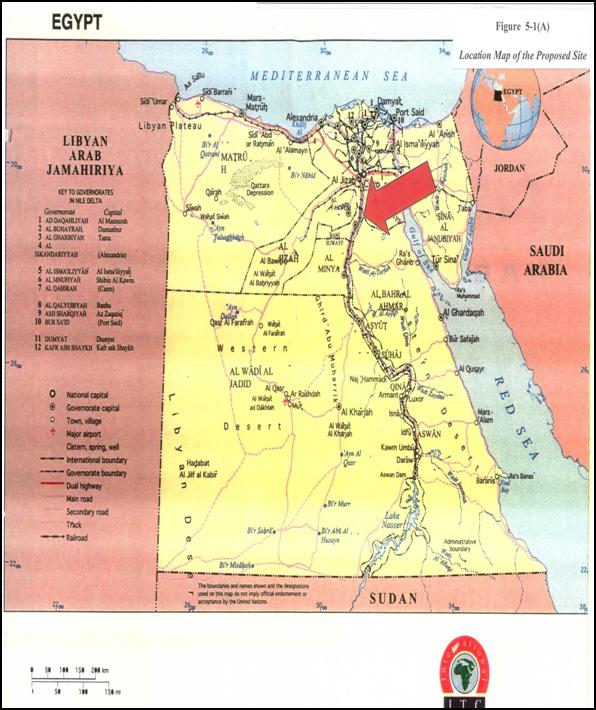
Figure 2
Location Map of the Proposed Site
within the ex-Helwan Governorate Context
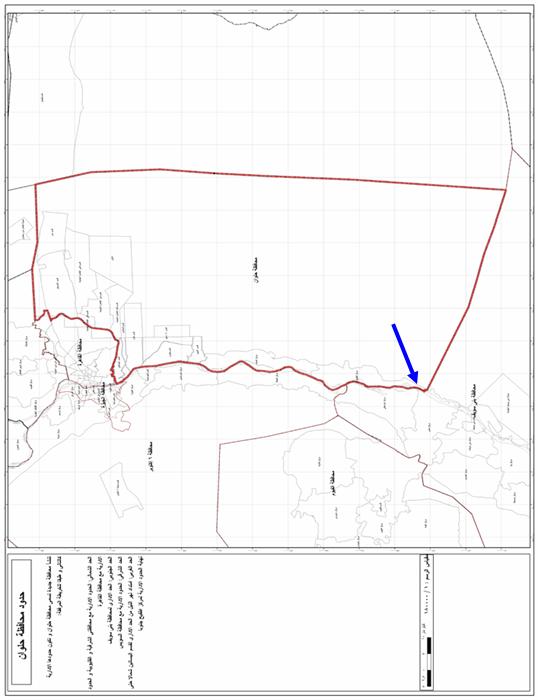
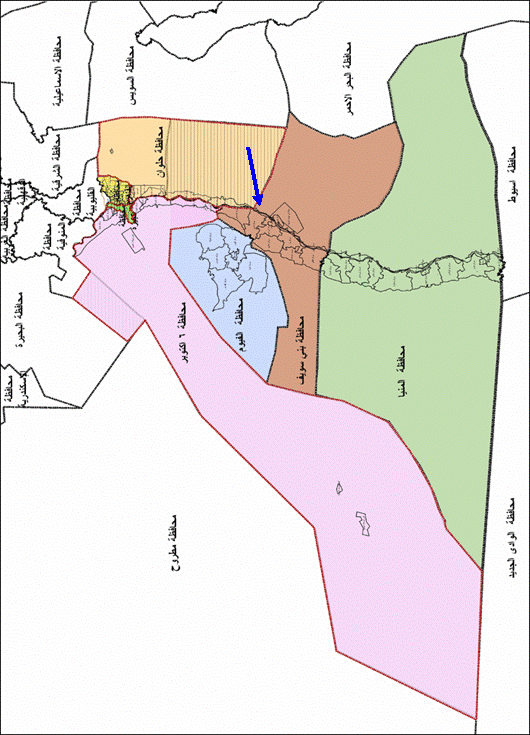
Figure 3
Map of the Wider Area of the Helwan South Site
within the ex-Helwan and Surrounding Governorates
2. THE ENVIRONMENTAL AND SOCIAL
IMPACT ASSESSMENT
2.1 Contributors to the EIA Report
1. The Environmental and Social Impact Assessment (ESIA) report is prepared by ECG, a private consulting firm (Egypt), based on many baseline studies undertaken by independent national and international consultants and on information provided by EEHC, UEEPC and their sub-contractors. Public consultation activities are undertaken by ECG and EEHC in conjunction with UEEPC. The ESIA report draws heavily on the environmental and social assessment documentation prepared by group of local and international multidisciplinary consultants and submitted to ECG, for preparing the ESIA report for local permitting purposes and financing requirements. All such documentations were reviewed by ECG and cleared for inclusion in this report. Most of the relevant local permits for the construction of the power plant have now been received (Further details of the relevant local permits are available in Section 2.3.1 of the main ESIA report).
2.2 Scope of the ESIA Report:
Legal and Administrative Framework
2.2.1 Government of Egypt Requirements
2. Beginning in the 1950s, the Government of Egypt has promulgated several laws and regulations concerning protection of the environment.
3. The Egyptian standards have been drawn from the range of provisions in the following documents:
· Law 4/1994 and the Prime Minister’s Decree No. 338 of 1995, which promulgates the Executive Regulations of Law 4.
· Amendment to the Law 4/1994 promulgated by the Prime Minister's Decree No. 1741 of 2005 for modifying some executive regulations of the Decree No. 338 of 1995.
· Law 9/2009, which modifies some provisions of the Law 4/1994.
· Law No. 93 for 1962 regarding the drainage of liquid wastes, particularly sanitary drainage.
· Law of Labor No. 12/2003.
· Law No. 38/1967 amended by Law No. 31/1976 on public cleanliness and collection and disposal of solid waste.
4. Law 4/1994 and Law 9/2009 require that, for establishments requiring licenses, an environmental impact assessment must be prepared and submitted to the Egyptian Environmental Affairs Agency (EEAA) for review. The environmental impact assessment must be submitted to the EEAA by “the Competent Administrative Authority (CAA) or the licensing authority” for the project in question. For the Power Plant Project, the Competent Administrative Authority is the Helwan Governorate.
5. The Helwan Governorate will send the EIA to EEAA for review and provide its opinion within 30 days. Once EEAA has approved the project, a license to proceed can be issued. No additional environmental or social clearances are required other than the EIA approval to proceed with the project activities. The law requires that any new project should comply with all the relevant articles pertinent to environmental attributes, which could be impacted from project activities.
6. Egyptian EEAA regulations specify the technical scope or contents of an environmental impact assessment. As a matter of practice, environmental impact assessments for power plant projects typically have a scope and organization similar to World Bank environmental assessments.
7. In addition to environmental impact assessment requirements, the Government of Egypt has established air pollution and water pollution limits applicable to the Power Plant project. These limits are discussed in Chapter 6, alongwith the actual air and water pollution levels expected from the Power Plant.
2.2.2 World Bank Guidelines and Safeguard Policies
8. The World Bank includes environmental impact assessment as an integral part of the evaluations it performs before financing a proposed project. The World Bank’s Operational Policy 4.01 (October 3, 1991 and its updates, 1999) provides guidance on the types of assessments that should be performed for different types of projects, and on the scope and content of those assessments. According to Operational Directive 4.01, thermal power plant projects require a full Environmental Assessment (EA).
9. World Bank Environmental Safeguard Policies provide 10 potential issues that may need to be considered in an EA, depending on the specific characteristics of each project. Table 2 summarizes the expected triggerability of the potential Safeguard Policies for the Helwan South Power Plant Project. The Safeguard Policies identified as “triggerable” are those which may be triggered and thus considered “Requiring Management”. When the detailed design of the Helwan South Power Plant has been determined, the UEEPC should prepare project-specific plans to manage these potential impacts.
10. No safeguard policies were triggered except for the Environmental Impact Assessment and the Involuntary Resettlement. Table-2 shows potential World Bank environmental Safeguard Policies and Helwan South project triggerability. The table justifies the triggerability or lack thereof for WB Safeguard Policies.
11. Annex B to Operational Directive 4.01 provides an outline of the information that should be included in a full EA. This Environmental and Social Impact Assessment follows the scope of Annex B.
Table-2
Potential World Bank Environmental Safeguard Policies
and the New Helwan South Power Project Triggerability
|
No. Safeguard Policy |
Applicability to Helwan South Project |
Policy Triggered? |
Justification |
|
1. Environmental Assessment |
Yes |
Yes |
· This policy applies to all projects requiring a Category A Environmental Assessment Under OP 4.01. · All environmental and Social aspects included in the New Helwan South project are adequately examined. · New Helwan South project is not likely to have significant potential (reverse) environmental risks & impacts in its area of influence (impacts on the natural environment: air, water & land; human health & safety; physical cultural resources; and transboundary and global environment concerns). |
|
2. Forest |
No |
No |
· No forest areas exist. |
|
3. Involuntary Resettlement |
Yes |
Yes |
· This policy applies to all projects triggering OP 4.12 · No relocation or loss of shelters. · No loss of assets or access to assets. · No loss of income sources or means of livelihood. · All activities related to the construction of the new plant will take place within on UEEPC land either on the site or on land directly adjacent to the site. i.e. no land acquisition. Not even temporary acquisition will result from the construction. · Experience from a number of similar power plants along the banklines of the Nile waters has shown that the impacts on fisheries of the discharge of warm water into the Nile waters have been positive. Consultations with the fishermen support this assertion. Impacts will be positive rather than negative, i.e. no loss of livelihood. · Transmission lines which will evacuate power generated by the Helwan South power plant will be extended as follows: o Construct 500 kV O.H.T.L double circuit SHPP 500/ Minya East 500(proposed) with length of about 200km. o Construct 500 kV O.H.T.L double circuit SHPP 500/ Bader 500 (under constriction) with length of about 150 km. Most of new transmission lines will be extended in a bare uncultivated, uninhabited, state owned desert land. No land take or resettlement will be associated to the power interconnecting lines. · A Resettlement Policy Framework (RPF) is prepared in order to handle any potential future changes. · Gas pipelines will be buried underground with no land take and fair compensation to any losses during excavation and land filling processes. · A separate RPF is prepared by GASCo in order to handle any potential future changes (GASCo has also prepared separate ESIA for the gas pipelines). |
Table - 2 (Contd.)
Potential World Bank Environmental Safeguard Policies
and the New Helwan South Power Project Triggerability
|
No. Safeguard Policy |
Applicability to Helwan South Project |
Policy Triggered? |
Justification |
|
4. Indigenous Peoples |
No |
No |
· The project does not affect the indigenous peoples in the project area. |
|
5. Safety of Dams |
No |
No |
· The project does not involve construction of a large dam. · The project is not dependent upon an existing dam. |
|
6. Pest management |
No |
No |
· Procurement of pesticides or pesticide application equipment is not envisaged. · The project will not affect pest management in any way. |
|
7. Physical Cultural Resources |
No |
No |
· Physical cultural resources are adequately examined. · The Helwan South project is not likely to have any significant impact on physical cultural resources. |
|
8. Natural Habitats |
No |
No |
· Natural Habitats are adequately addressed and examined. · The Helwan South project is not likely to have any significant impacts on natural habitats. |
|
9. Projects in Disputed Areas |
No |
No |
· The UEEPC/EEHC is not involved in any disputes over an area with any of its neighbors. · The project is not situated in a disputed area. · Any component likely to be financed as part of the project is not situated in a disputed area. |
|
10. Projects on International Waterways |
Yes |
Yes |
The impact of the project on the Nile River, which is an international waterway, as per the Bank’s policy on projects on international waterways (Operational Policy 7.50) is addressed in the following topics: · Type of cooling system. · Source of water abstraction (surface water and ground water). · Pre-treatment of abstracted water before use inside the plant. · Water requirement per day for - (i) industrial cooling; (ii) processing or cleaning; and (iii) for domestic consumption by facility staff. · Water discharge per day from - (i) cooling/heating system, blow downs; (ii) storm water; and (iii) from use in toilets; floor cleaning, colony etc. · Point of discharge of water from power plant - directly into the water body. · Amount of discharged water from power plant - (i) untreated directly into water body and (ii) treated directly into the Nile River. · Average seasonal flow of water in the river water cum/hr (seasonal variation - minimum and maximum). · Average characteristics of water in the river (pH, total dissolved solids; suspended solids; chloride; sulfate and metals). |
Table - 2 (Contd.)
Potential World Bank Environmental Safeguard Policies
and the New Helwan South Power Project Triggerability
|
No. Safeguard Policy |
Applicability to Helwan South Project |
Policy Triggered? |
Justification |
|
|
|
|
· Average anticipated characteristics of discharge from (i) cooling system and (ii) from colony and non-industrial/process facility. · Information on mixing zones at the point. · Information about presence of fishes and other aquatic species in the Nile River including fish catch etc. · Distinguishment between the consumptive use of water (abstracted water that is not returned back to the source of abstraction) and non-consumptive use (abstracted water that is returned back to the source of abstraction.
Main answers of the above topics are given in the ESIA Report per One Unit as follows: · Service water(1): 30.0m3/hr (11.11% consumed(2)= 3.34 m3/hr and 88.89% recycled(3) = 26.67 m3/hr) · Boiler make – up water : 31.25 m3/hr (totally recycled) · Cooling water : 82,800 m3/hr (0.07% consumed = 57.96 m3/hr and 99.93% recycled = 82,742.04 m3/hr) · Total water usage : 82,861.25 m3/hr (consumed = 61.295 m3/hr, recycled = 82,799.955 m3/hr ) · Cooling water abstracted from the Nile River (23m3/sec. per unit, i.e. 82,800 m3/hr.) is returned totally back to it. Actual water consumption is around 0.07% of the abstracted water. · No disturbance to the Nile flow is expected either upstream or downstream. · Hydrological/hydraulic study is carried out and the study revealed that no impact is expected and the mixing zone is limited to 50-70m distance with 5oC above ambient, which is diluted to 3oC at a distance between 100 and 150 m with full compliance with Egyptian Law 48/1982 and WB regulations. · All waste water is treated. Water treated directly into waterbody: 120-220 m3/hr. · MWRI is in full agreement with EEHC regarding its plan for water abstraction. Average seasonal flow of water in the Nile River is as follows: · Minimum flow (Winter time): 60 million m3/day at a MSL of 21.28m (6.63% of the Nile total). · Dominant flow (Average time): 90 million m3/day at a MSL of 23.63m (4.42% of the Nile total). · Maximum flow (Summer time): 250 million m3/day at a MSL of 24.36m (1.59% of the Nile total). |
Notes:
(1) "Service Water" includes water for utilities (toilets; floor cleaning; sanitary)
(2) Consumption = predominantly consumptive use.
(3) Recycling = predominantly non-consumptive use; returned to the original source.
12. In addition to environmental impact assessment guidelines, the World Bank has established guidelines concerning air pollution and water pollution form thermal power plants (Pollution Prevention and Abatement Handbook-Part III (July 1998)). The guidelines were officially published in 1988; since then, several sets of revisions have been proposed, most recently on March 22, 1996. The 1988 and proposed 1996 guidelines are discussed in Chapter 6, along with the actual air and water pollution levels expected from the Power Plant. Also, the most recent updates of the World Bank Guidelines, issued in 2007 and in December 2008 have been considered.
13. World Bank’s Pollution Prevention and Abatement Handbook-Part III (July 1998) also, provides with principles of industrial pollution management, monitoring and air emission & effluent discharge requirements presented in the industry Guidelines including Guidelines for New Thermal Power Plants.
14. Public Consultation Process has been designed in accordance with World Bank Guidance for the Preparation of a Public Consultation and Disclosure Plan (January 1996);
15. The ESIA has assessed the impacts of the construction and operation of the New Helwan South Power Plant and has also considered the cumulative air quality impacts of the plant and other existing sources in the project area, including the small and medium sized local manufactures. Consideration has also been given to the operation of the transmission line and other outside facilities, including natural gas pipeline, which will feed the power project with gas fuel. The ESMP will be revised after exact route of both transmission lines and gas connection are available. Permits will be required from the relevant Competent Administrative Authorities.
16. The ESIA report presents the full assessment of the environmental, social, health and safety impacts of the Helwan South power plant. This Executive Summary presents a short resume of the findings of the ESIA report. For further details, reference should be made to the full ESIA report.
3. GENERAL SETTING OF THE SITE:
DESCRIPTION OF THE ENVIRONMENT
17. The Helwan South site is located within a bare sandy area of uncultivated land. It is entirely situated on approximately more than 37 hectare rectangle- shaped piece of land located in a rural/desert area approximately 10 km south of the village of Kureimat, in the Helwan Governorate on the east bank of the Nile river. The site of the new Helwan South 1950 MWe power plant facility is an area of about 276,000 m2 within the existed allocated site. The site locus is approximately 100 km south of Cairo and 23 km north of Beni-sueif. Two physiographic zones occupy this area: a floodplain adjacent to the Nile, and a rocky desert plateau east of the floodplain. The site of the existing land is 450 meters wide and has an average length of 800 meters; in all the site encompasses 378,000 square meters (see Figure-3).
18. On the north side of the site is the Kureimat Power Complex (2x600 MWe+ 2x750 MWe), at around 7.5 km and the Kureimat village (about 10 km) and the Helwan South irrigation pumping station (about 9 km). The site is about 700 m south of the Dayr al-Maymoun village. On both of the south and the east sides of the site is a wide-extended desert land. On the east side, and across the power plant site is a two-lane road running paralle to the Nile river. On the western side of the site is an agricultural stripland parallel to the Nile river where the power plant's cooling water intake and discharge structures will be located.
19. The nearest town of importance is Es-saff, Markaz Es-saff, about 38 km along the road in the north direction. Towns of importance in the wide vicinity of the power plant site are Atfieh, Helwan, Giza, Imbaba, 15th of May, Beni-sueif and El-Wasta. The general site location is shown in Figure-4 (A through G).
20. The site entirely consists of approximately flat land, which is owned by the Upper Egypt Electricity Production Company (UEEPC). Localized map of the proposed site is shown in Figure- .
21. The land is identified by boundary lines determined by the coordinates of the proposed site. Key points are given in Figure , which indicates the following coordinates:
|
|
North (N) |
East (E) |
|
1. |
723619,80 |
636394,86 |
|
2. |
723831,95 |
635925,12 |
|
3. |
723187,29 |
635612,19 |
|
4. |
722918,38 |
636072,77 |
22. More determining coordinates are presented in Figure- .
23. The Helwan South site is located on the western edge of the North Galala Plateue, a desert environment ranging in elevation from 330 to 1,275 meters above sea level. Wadis drain into the Nile river from the west slope of the plateau. The development of the site did not affect the drainage in adjacent areas. The river bank in this reach of the Nile (El- Wasta to Beni-sueif) is generally steep, consisting of small floodplain areas on the east bank; however, more extensive agricultural lands occur on the west bank. Flat desert lands above the east bank (Figure 5-5(B)) extend some 35 km inland to the Galala Plateau ridge. This area is not irrigated, but sporadic grazing occurs throughout the plateau.
24. The power plant site is located immediately above a river floodplain and just upstream and downstream of Helwan South Island, away from the cultivated area. Small oases occur about 1 km south of the site, and immediately to the north of the site. These oases are located on wadis at their confluences with the Nile flood-plain. The oases and adjacent floodplain are used to grow a variety of fruit, vegetable, and forage crops and to graze livestock. The natural growth of palm trees and shrubs, combined with fig trees and other cultivated woody plants, provides habitat for a variety of songbirds and some shorebirds.
25. Natural stream bank vegetation forms a narrow border to the river and consists of Scirpus, Juncus, Phragmities, Typha, and other emergent species. Snails are abundant along the shoreline, as are nematodes and other bottom worms in shallow water. The shoreline also shows evidence of high siltation and periphytic growth. The shoreline is already stabilitized as a part of the existing project. The elevation is on average not changed in the cultivated area but all areas are of uniform elevation.
26. Above the floodplain the topography of the site consists of an abrupt slope followed by a flat plateau some 300 meters to the east. The elevation difference from the Nile at summer flow levels to this plateau is approximately 20 meters. The site's eastern most boundary extends along the main north-south highway and includes a major wadi. The flow through this wadi during storm periods would be blocked east of the highway's elevated road bed.
27. The Helwan South site is within the Atfieh local governing unit, with the city of El-Saff as the governing center of the district. No villages or individual residences are located on the site. Agricultural workers who farm the floodplain live in nearby villages. Kureimat village is located some 10 km to the north of the site and Figure 5-5(C) shows the view of the nearest part of the village from the road to the site.
28. The site is located within a totally rural landscape with some small scattered residential communities.
29. Supply to the site is possible via railroad, road and barge from Alexandria, El-Dekheila, Damietta, Suez-Gulfor or others. The power plant location can be reached by previously mentioned two-lane road which branches off the agricultural road connecting Alexandria with Cairo. This access road has a width of about 12 m starting from Helwan. The part of this access road which passes the Helwan South site is paved but is full of asphalt pocket.
30. The project area lies within the hyperarid climatic province of Egypt characterized by a mild winter and hot summer.
31. Vegetation cover types within the site boundaries and in surrounding areas consist of three categories: emergent marsh wetlands adjacent to the Nile river, cultivated areas on the historical river floodplain, and barren desert on the eastern plateau.
32. Agricultural crops have been cultivated on the higher floodplain and at the mouth of several small wadis at the project site between the 23 m and 28 m elevations.
33. At least two different crops are planted annually on the lower areas, and in August, corn and peanuts are the predominant crops. Winter wheat is to be planted after the corn is harvested. Orchard and perennial crops included grapes, melons, guava, lemon, Indian fig (Opuntia ficusindica) and castor bean.
34. Generally, the project area is an agricultural-desert landscape. In the vicinity of the project site, almost no human settlements of any significant size occurs.
35. There is a typical rural housing with many small villages. The nearest villiage to the site is at about 1 km. No housing, except the existing plant's colony, occurs in the immediate vicinity of the site which is totally surrounded by desert, agricultural and farm lands. The satellite image taken recently (Figures 5-1(D, E and F)) shows that these lands are as described.
36. There are no significant habitats within the project's area of influence.
37. The primary wildlife species observed onsite during the November 2010 field reconnaissance were birds. Within the wetlands, the cattle egret (Bubulcus ibis), moorhen (Gallinula chloropus), common swallow (Hirundo Rustics), and graceful warbler (Prinia gracilis) were commonly observed in the Scirpus – Juncus marshes. Most of the avian activity, however, was centered in the agricultural areas. Swallows were observed foraging the fields. Cattle egrets, spur-winged plovers (Hoploterus spinosus), crested larks (Galerida cristata), and Senegal stone curlews (Burhinus senegalensis) foraged on the ground in the fields. Palm doves (Streptopelia senegalensis) were commonly observed foraging on the ground as well as resting in the trees. No birds were observed in the desert on the site.
38. In addition, the field surveys have indicated that non-of the floral and faunal communities and/or species are of conservation value (rare or threatened). Meanwhile, no natural protectorates exist near the vicinity of the proposed site.
39. No industry, other than the existing Kureimat power complex, is present near the site. Thus, the air in the background atmosphere is of appropriate quality.
40. No archaeological resources are known in this zone. During February 1991 and before the construction of the existing Kureimat power plant, Kathryn A. Bard and Ricardo J. Elia of the Office of Public Archaeology, Boston University have conducted Preliminary Archaeological Assessment for the Kureiamt, Egypt Feasibility study. Also, the local archaeological authorities have surveyed the whole area around the site and they all proved that no historical resources exist.
41. Two water sources are available near the site, i.e. the Nile river and the underplaying aquifer. The quality of both surface water and groundwater in the Helwan South reach of the Nile is generally good. Only in localized sectors where there are concentrated sources of contaminants, such as irrigation drainage return waters, would water quality degradation be expected to occur.
42. The groundwater basin, which lies both beneath and closely adjacent to the Nile Valley from Cairo to Aswan, includes an area of about 2 million feddans. Water storage in this linear basin has been estimated at approximately 27 billion m3. However, because the hydrologic balance of the Nile Valley alluvial aquifer is directly connected with Nile surface flows, production from the aquifer is nominally the same as withdrawing water from the river. In essence, the valley aquifer is a transmission medium for river surface resurces.
43. The proposed site lies within the administrative boundary of the Helwan Governorate, which is recently formed as a distinct Governorate, separated mainly from Cairo and Giza Governorates, where most of its Kisms / Marakez / Districts/ Cities were basically affiliated to Cairo and Giza Governorates. The Governorate of the Helwan has prepared an Urgent Development Plan (UDP) for land-use management and planning, in which it sets out its policy to control development in the the Helwan South region up to 2017 and beyond.
44. The Helwan Region Strategic Plan, 2009 is shown in Figures 9, (A) & (B) . The proposed land uses around the project site include new industrial, urbanized and residential development areas, which discussed in more detail in Section 5.8.
Figure 4 (A)
Landsat Image of the Wider El-Kureimat and Atfieh Area
Showing the Proposed Site of the Helwan South Power Plant

Figure 4 (B)
Enlargement of the Helwan South Power Plant Area

Figure 4 (BB)
Enlargement of the Helwan South Power Plant Area

Figure 4 (C)
Schematic Layout Drawing of the Helwan South Power Project

Figure 5
Locailzed Map of the Proposed Site

Figure 6
General Area Map of the Helwan South Power Plant
with Locations of Permanent Control Points

Figure 7 (A)
Some Photos for the Power Plant Site
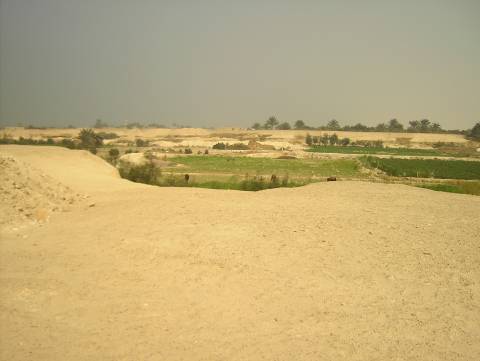
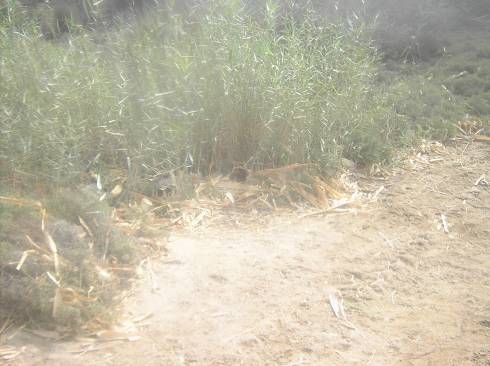
Figure 7 (B)
Some Photos for the Power Plant Site


Figure 8 (A)
Area Setteing of the Power Plant Site

Grain Silos to the North of the Site

Agricultural Stripland to the West of the Site
Figure 8 (B)
Area Setteing of the Power Plant Site

Figure 9 (A)
Helwan Strategic Planning Master Scheme, 2009

Figure 9 (B)
Urban Development Plan for the ex-Helwan Governorate, 2009

4. PROJECT DESCRIPTION
4.1 Overview of the Power Plant
1. The power plant site will occupy an area of approximately 276,000 m2, within a total allocated area of 378,000 m2 rectangle-shaped piece of land and will include the following main elements for each 650 MWe Unit:
· Supercritical steam power plant, comprising two generating units primarily fired by natural gas, at approximately 9-11 bar gauge at the interface, but also designed to run on mazout (heavy fuel oil) in emergency situations as a secondary fuel. Each unit will consist of one outdoor supercritical steam generator for steam generation and one supercritical steam turbine generator (STG) providing 650 MWe (nominal) electrical generation capacity per unit at the 100% of the STG output case. Each STG will be fed by steam from the respective steam generator (boiler);
· Circulating water system, with the main pumps and associated piping, the intake and discharge structures, the screening system, the chlorination system and the cathodic protection system;
· Heavy fuel oil and light fuel oil storage tanks;
· Intermediate water storage, the demineralization plant and the make up water system; and
· Power will be generated at the manufacturer’s standard voltage and stepped up through main transformers to be connected to the new 500kV GIS switchgear.
2. The power plant will include the following main components:
· Boiler Unit 1 A.
· Boiler Unit 1 B.
· Boile Unit 1C.
· Auxiliary Boiler.
· Steam Turbines Units 1 A, 1B&1C.
· Elec. Bldg. ,all units.
· Elec. Control Bldg. ,all units.
· Main Transformers Unit 1 A.
· Main Transformers Unit 1 B.
· Main Transformers Unit 1C.
· Aux. Transformers Unit 1 A.
· Aux. Transformers Unit 1 B.
· Aux. Transformers Unit 1C.
· Switchyard Area.
· Diesel Generator.
· Switchgear Control Room.
· Stacks Module 1.
· Fuel Gas Receiving/Reducing Station.
· Mazout Fuel Oil Unloading Pumps.
· Sollar Oil Unloading Pumps.
· Mazout Fuel Storage Tank 1.
· Mazout Fuel Storage Tank 2.
· Sollar Oil Unloading Pumps.
· Mazout Oil Heaters/Transfer Pumps.
· Sollar oil Storage Tank.
· Water Treatment Area.
· Circulating Water fire Water Pump House.
· Circulating Water Electrical Equipment Bldg.
· Chlorine Tank/Pump.
· Condensate Water Tank.
· Condensate Water Discharge Structure.
· Condensate Water Nile l Well.
· Demineralized Water Storage Tank.
· Waste Water Treatment Plant.
· Administration Building.
· Warehouse/Work Shops.
· Security office.
· Fire Station.
· Hydrogen Generation Building.
· Bottled Gas Storage/Gen. Area.
· Foam Equipment.
· Black Start Facility.
3. The power plant is designed to operate as a base load unit with the STG operating in sliding pressure mode up to approximately 60% load and at fixed pressure for higher loads.
4. The layout and main components for the power plant is presented in Figure 10.
4.2 Process Description
5. The key steps of the generating process of the proposed power plant are as follows:
· The key inputs to the generating process are natural gas or mazout oil, which will be delivered to the site via underground pipelines (gas or mazout), together with air and water.
· Natural gas (or mazout oil when natural gas is unavailable) will be mixed with air and combusted to generate steam from demineralized water to drive three turbines serving electrical generators. The combustion of the fuel is supported by injection of air. The process results in the generation of electricity and also produces hot exhaust gases.
· The steam is cycled from the boilers through the turbines to condensers. The condensers are cooled by a direct cooling system, abstracting water from, and discharging the used effluent to, the River Nile. The condensate is then returned for recirculation within the boilers.
· The final exhaust gases will be discharged to the atmosphere via a flue housed in a single stack of 152 m height for each unit in accordance with emission standards set by the EEAA. The main by-products from combustion of natural gas are carbon dioxide (CO2), water vapour, carbon monoxide (CO) and nitrogen oxides (NOx). Sulfur dioxide (SO2) and particulates, which are typically associated with coal and oil combustion, will not be produced other than in trace quantities during natural gas firing. When mazout oil is used instead of natural gas (in emergency situations for only less than 2% of the total operating hours), SO2 and particulates will also be key emissions from the power plant.
Figure 10
General Layout of the Helwan South Power Plant
and its Easments

4.3 Operational Releases from the Power Plant
1. During operation, the key releases into the environment from the power plant will comprise the following:
· Exhaust gases, will be emitted into the atmosphere, normally from the Boilers’ stack as a result of fuel combustion. Emissions from the combustion of natural gas are carbon dioxide (CO2), water vapor, carbon monoxide (CO) and nitrogen oxides (NOx). Sulfur dioxide (SO2) and particulates, which are typically associated with coal and oil combustion, will only be produced in trace quantities during natural gas firing. In emergencies when heavy fuel oil (mazout) is used instead of gas, SO2 and particulates will however be key emissions from the power plant.
· Heated cooling water will be discharged into the River Nile via the cooling water discharge structure at a temperature of no more than 9.6oC at the point of discharge. Process waste water will be treated and discharged into the discharge system, which includes two pathways: one to the circulating water discharge system (CWDS) and the other to the plantation irrigation network. Any oil and residual solids will be removed before discharge and the pH of discharged water maintained at between 6 and 9.
· Chlorine will be added to the cooling water system to control bacterial and algal growth on various surfaces and in the cooling water intake. The cooling water discharge will contain residual quantities of chlorine at concentrations below the World Bank standard for free chlorine of 0.2 mg/l.
· Small volumes of solid wastes will be segregated, collected and disposed of by licensed waste disposal contractors.
2. The power plant incorporates a range of measures to eliminate or reduce operational releases within its design and layout, such as low NOx burners in the boilers, oil interceptors fitted to the site drainage system and effluent treatment facilities to treat wastewater prior to discharge. As a result, the power plant is designed to meet high environmental standards and comply with the emission limits of the Arab Republic of Egypt and the World Bank.
5. ANALYSIS OF ALTERNATIVES
5.1 Current Situation (“No Action” Option)
3. The no action alternative will result in the demand for electricity exceeding supply, with an increasing deficit as demand increases in future years. A lack of a secure and reliable electricity generation and supply system has significant social and economic implications, since it will:
· constrain existing and future economic development and investment through lack of energy resources to meet industrial demand;
· restrict socio-economic development through lack of electricity supply, or poor reliability and shortages in electricity supply for domestic users, community and other public facilities and public services;
· inhibit provision of social services, including public health and poverty eradication.
4. As a result, the "no action" option is not a viable or acceptable alternative to the proposed project.
5.2 Planned Additional Capacity and the Helwan South Power Plant
5. The EEHC has established a generation expansion plan which is intended to achieve the following:
· meet future demand for electricity;
· maintain and improve generation and transmission reliability; and
· introduce new technologies.
6. The expansion plan also corresponds to the national Government’s development aspirations and growth poles of economic and industrial expansion throughout the country. As part of this plan, the EEHC has identified Helwan South power project to help implement its expansion in generation capacity. Hence, the proposed project is compatible with and, indeed, a fundamental part of the EEHC generation expansion plan to meet existing and future demand for electricity.
5.3 Alternative Technologies And Fuels
5.3.1 Selection of the Proposed Technology
7. The EEHC has an objective to provide a secure, reliable electricity generation and distribution system for Egypt. A key element in meeting this objective is to establish a diverse range of technologies to avoid over-reliance on any particular fuel or technology, which may adversely affect the ability to provide electricity or meet the fluctuations in demand which occur on a day-to-day or seasonal basis.
8. The EEHC generation expansion plan includes provision of the following:
· gas/oil-fired steam units;
· gas/oil-fired combined cycle units;
· gas/oil-fired simple cycle combustion turbine units;
· pumped storage;
· nuclear generation;
· wind farms; and
· integrated solar-thermal generating units.
9. Other possible options include “importing electricity”, “rehabilitation of existing power plants”, “transmission and distribution investment” and “IPPs”.
These technological alternatives constrained by the following:
· Importing electricity: Egypt is interconnected to Libya and Jordan and is exporting electricity to both countries. Interconnection to Libya has a capacity of 300 MWe, and that of Jordan has a capacity of 350 MWe, which was increased to 450 MWe in 2006. Libya and Jordan are currently paying 4 US¢/kWh for the Egyptian power supply. As they are net importers, there is currently not much scope for electricity imports to Egypt from the interconnected networks. In addition, the cost of electricity in both countries is much higher than that of Egypt, making it an uncompetitive alternative. There is currently no south border connection to Sudan, although there is an ongoing activities in the context of the Nile Basin Initiative (NBI) whereby Egypt could potentially import hydroelectric power starting approximately in 2014, if the price is competitive. However, considering the abundance of natural gas and thus the low cost electricity provision in Egypt, it will be difficult for imported electricity to be competitive.
· Renewable energy: Current world market cost of wind based electricity is 5.9-7.38 US¢/kWh, whilst is 3.75 US¢/kWh with current grant financing for wind projects, which is higher than the cost from natural gas thermal plants. Therefore, renewable energy is not competitive unless further subsidies are provided.
· Rehabilitation of existing power plants: EEHC has concluded that the rehabilitation option is cost effective in seven of its existing power plants, and these sites have already been or will be rehabilitated. However, these efforts are not enough to cope with the growing demand for electricity.
· Transmission and distribution investments: EEHC has developed a transmission and distribution (T&D) development plan and the T&D system is optimized for the current load requirements and generation capacity. To meet the demand growth for the fast track period and medium term expansion, a T&D investment plan has been developed. New electricity generation capacity is required in the network; therefore, strengthening of T&D capacity alone will not replace the need for the generation capacity. Furthermore, T&D losses are at a relatively low level, around 10% on average, and reducing the losses further would not free up the amount of electricity supply required.
· BOOTs/IPPs: Three BOOT projects (650 MWe each) have been built in Egypt in late 1990's and early 2000's. The government is encouraging private sector participation in order to attract private investment. However, given the worldwide reduction in investor’s interest in the power sector, private financing for power generation in the near term is still in process.
10. Consistent with the generation expansion plan, the EEHC has stipulated that the Helwan South should be gas/oil-fired supercritical steam units of a net 3x650 MWe generating capacity. The reasons for the selection of this technology are as follows:
11. The steam cycle (SC) technology, which fires natural gas as a main fuel and mazout as a back-up fuel, has been used for decades in Egypt. The plant efficiency is around 46% with 600 MWe size drumless type super-critical steam cycle, which exceeds the similar sub-critical unit efficiency with at least 4% ratio. The investment cost of Steam Cycle Super-critical plant, based on recent worldwide market experience, is around $ 1700/kWe (EPC basis with multiple packages). The application of large scale (750MWe) gas turbine combined cycle (CC) technology, which fires natural gas as a main fuel and diesel fuel as a back-up fuel, has been operational since 2004. Plant efficiency exceeds 50% and the investment cost, based on recent worldwide market experience, is around $760/kWe (EPC basis with multiple packages). Given that CC plants show lower investment cost and higher plant efficiency, there should be a distinguished rationale to justify why the SC technology has been selected for the proposed project. The reasons are the following:
· Operational flexibility: The EEHC plans to operate large scale (i.e., 750 MWe) CC plants at 100% full flat base-load with a possibility of reducing operations to 50% once a week. This is because the cycling capacity of large-scale CC plants is still to be confirmed (frequent start and stop, and partial load operation capacity). Consequently, SC plants are required to take the role of reducing the load, while CC plants keep 100% full load. EEHC therefore sets the maximum proportion of CC in the generation mix to be 30-35%. As a result, the Electric Generation Expansion Analysis System (EGEAS) model selected the proposed Helwan South SC plant as the most viable option based on this generation mix criteria. If the CC technology were selected, it would exceed the limit of CC in the generation mix, requiring CC plant cycling operation beyond what it is capable of.
· Grid stability: SC turbine has bigger inertia and is therefore more stable to network disturbances. When the CC ratio is too high in the generation mix, CC may overreact to the disturbances and interfere with each other, which could cause load instability.
· Unforeseen risk of new technology: Applying a new technology to the Egyptian specific climate and environment may have unforeseen risks. For example, recently, dust and humidity caused a quick filter pressure drop in the Cairo North plant, commissioned in May 2004, which was not expected when the CC plant was designed.
· Fuel flexibility: SC plants use mazout as a back-up fuel, easily available domestically, while CC plants use imported diesel oil. The ability to "dual-fuel" the power plant (with natural gas or mazout) will provide security of electricity supply in the event that gas supplies are unavailable for any reason.
· Local manufacturing capacity: In Egypt only 30% of CC plants are manufactured locally, in comparison to about 40-45% of SC plants manufactured locally. Therefore, the use of SC technology creates more local employment and requires less foreign exchange.
12. Given this rationale, existing and planned generating capacity using gas/oil-fired combined cycle units is already considered sufficient by the EEHC and further reliance on this particular technology is not preferred for reasons of security of supply, response to demand and economics. As shown in Table 3-1, almost 29.88% of installed capacity in 2008/2009 was provided by combined cycle technology. The new combined cycle units at New Kureimat and El-Atf, Sidi Krir and New Talkha have added more 3000 MWe to the installed capacity within the last 2 years. Also, declared combined cycle additions of Giza North (3x750) MWe and Banha (1x750) MWe will increase the combined cycle capacity by another 3000 MWe within the next 2 years. The EEHC is implementing a process of meeting and generating increased demand through the provision of conventional steam generation plants in order to generate sufficient demand to install further CCGT capacity in the future. This will result in increased potential to incorporate more CCGT capacity.
13. Hence, with the current policy to limit CC to 30-35% in the generation mix (as identified by EGEAS), and with urgent need of supply capacity with load following capability, SC technology has been identified as the most viable option for the Helwan South project. This will ensure operational flexibility, network stability, fuel flexibility, local job creation, and avoid unforeseen risks of applying new technologies too rapidly in Egypt.
5.3.2 Alternative Fuels
14. Natural gas has been selected as the main fuel for the power plant. Compared to other fossil fuel generating technologies, gas fired steam generators have a relatively low emissions of carbon dioxide (CO2), moderate emission levels of nitrogen oxides (NOx) and the lowest emission levels (almost traces) of sulfur dioxide (SO2) and particulates.
5.4 Alternative Sites
15. The site location has been allocated to the Upper Egypt Electricity Production Company (UEEPC), an affiliated company to the Egyptian Electricity Holding Company (EEHC) by the Egyptian Government (Presidential Decree no. 43 of the year 2010, issued on 14 February 2010).
5.4.1 Identification of Candidate Sites
16. Three sites were considered for the proposed project, namely Safaga, Sharm esh-Sheikh and Helwan South. Relatively, the Helwan South was preferred to Safaga and Sharm esh-Sheikh sites mainly because of the higher cost for connection to cooling water, make-up water and the gas network, in addition to the electricity grid due to the greater distance to the load centers.
17. The key criteria used in the evaluation of the alternative sites by the EEHC/ UEEPC were as follows:
· Economic factors:
- capital costs;
- operation and maintenance costs;
- requirement for natural gas;
- requirement for cooling water;
- demand loads for electricity; and
- requirement for electricity transmission lines/sub-stations.
· non-economic factors:
- potential environmental impacts; and
- site development.
18. Potential environmental impacts have been examined for all sites. Screening level assessment during feasibility study indicated that the level of environmental impacts will be relatively constant for all the three sites.
19. According to the Investment Map and Land-use Map of Egypt, the South Helwan/ Kureimat has been designated since 1999 to industrial development. Some of the land around has already been developed with industry facilities. As a result, the Helwan South on the Nile River area has been identified as the centre of load for current and future electricity demand in the region.
20. Compared to other alternative sites, the Helwan South on the Nile River site was found to be the most effective site for the following reasons:
· Minimal additional infrastructure requirements are needed.
· A workers colony is not required during construction as the power plant will use the local workforce from Helwan Governorate and the surrounding towns and villages.
· Desirable benefits for development of the site area.
21. In addition, the power plant will be constructed and operated on a land originally allocated for power generation activity, thus it will not include any land take. Also, the power plant site will bring socio-economic benefits to the wider Helwan Region, through employment opportunities, supply contracts and the effects of project expenditure within the local economy.
22. The key findings of the consideration of alternative sites are summarized in Table-3. The consideration of alternative sites by the UEEPC/EEHC indicated that Helwan South has no significant disadvantages and has several beneficial aspects for other developments in the Helwan and Atfieh / Kureimat area, and desirable site development characteristics. Therefore, Helwan South was selected as the preferred site for the power plant.
Table-3
Key Findings of the Consideration of Alternative Sites
|
Site |
Key Findings |
|
Safaga |
Remote, "greenfield" site, hence a new colony for workers would be required with potential socio-economic conflicts. Extensive infrastructure requirements needed, resulting in higher costs and potential environmental impacts.
|
|
Sharm esh-Sheikh |
Relative to Helwan South site, significant infrastructure requirements needed, resulting in higher costs and potential environmental impacts.
|
|
Helwan South |
Minimal additional infrastructure would be required. Cost-effective site for development (first lowest of the three alternative sites). A workers colony is NOT required as the project will use the local workforce from wider Helwan area.
|
6. KEY FINDINGS OF THE ENVIRONMENTAL
IMPACT ASSESSMENT
6.1 Introduction
23. A thorough assessment of the impacts of the proposed plant has been carried out based on information provided by EEHC, UEEPC and their sub-consultants. A combination of quantitative and qualitative assessment techniques, ranging from computer and/or physical modeling for air, water, noise and traffic impacts to ecological and aquatic surveys and visual evaluation, have been undertaken. The results of the assessment work have been coِmpared with the environmental standards set by the Government of the Arab Republic of Egypt and the World Bank, whichever is the more stringent.
24. The following items are examined in the corresponding sub-sections of the ESIA Study Report:
- Air Quality;
- Aquatic Environment;
- Noise and Vibration;
- Flora and Fauna;
- Land use, Landscape and Visual Impacts;
- Soils, Geology and Hydrology;
- Traffic;
- Socio-economics and Socio-cultural Effects;
- Archaeology, Historical and Cultural Heritage;
- Natural Disaster Risks;
- Major Accident Hazards;
- Solid Waste Management;
- Public Health Effects;
- Occupational Health and Safety; and
- Associated Infrastructure.
25. For each of these items, a concise description and evaluation of the significance of potential impacts of the project is presented in the ESIA study report. Where modeling has been undertaken, a description of the model as well as corresponding maps summarizing the results of the assessment are provided.
26. Where potentially significant adverse impacts are identified, possible mitigation measures are suggested wherever possible, to ameliorate the impact to an acceptable level. Where identified, beneficial or positive impacts/effects of the project are also highlighted.
27. The conclusions of the assessment (see Table 4) are that (with suitable mitigation measures described in Tables 5, 6, 7, 8 and 9) the project is in compliance with the environmental requirements of both the Government of Egypt and the World Bank with respect to stack emissions of the new power plant, ambient air quality, discharge quality and noise. Table 1 provides with a summary of anticipated impacts in relation to the Egyptian and World Bank environmental guidelines for stack emissions, ambient air quality, liquid effluent and noise. The following discussion highlights some of the key considerations and results of the assessment.
6.2 Air Quality
Construction Dust
28. Construction activities will result in locally high levels of dust. This may affect nearest receptors or sensitive environments which lie in the immediate boundaries of the power plant. Existing concentrations of airborne dust are already high in this rural area. Potential impacts from dust emissions on site will be significantly reduced by careful management and the implementation of mitigation measures to reduce dust generation.
Stack Emissions and Background Air Quality
29. The power plant will burn natural gas as its primary fuel. As a result, the principle pollutant during normal operation will be NOx. During emergency operation (and for not more than 2% of operating time), the burning of light fuel oil will result in emissions of particulate matter and SO2 along with trace amounts of other pollutants. Emissions from the plant will meet Egyptian and World Bank Guidelines.
30. In order to analyze the potential impacts of the plant’s emissions during normal operation (firing gas) on ambient air quality in the project area, dispersion modeling has been undertaken.
31. The assessment indicates that the highest concentrations for each of the averaging periods under consideration (hourly, daily, annual) are found to the north-north-west, south and south- south-west of the site, respectively. This is because the winds are exposed to the atmospheric prevailing conditions, although they are overwhelmingly from the north and northwest for most of the time. The maximum hourly average value is 367.3 mg/m3 at 608.9 meters (-305.0m, 527.0 m), the maximum 24-Hours average is 126.7 mg/m3 at 623.0 meters (5.1 m, -622.9 m) and the maximum annual average is 37.3mg/m3 at 630.1 meters (-95.0 m, -622.9 m). The ambient existing levels of pollutants are dominating the wider area of the Helwan South site. Combined effects from the proposed Helwan South power project and the surrounding sources for nitrogen oxides (NOx) have been obtained using the background NOx measurements recorded for the Helwan South area via the NRC. The maximum total combined 24-hour impact level (138.79mg/m3, including the background level) is under the Egyptian 24-hour limit of 150 mg/m3. The maximum 24-hour impact level of the Helwan South power project is 126.7 mg/m3 (excluding the background level). The maximum combined 1-hour impact level, including the highest value during 2008, is 397.52 mg/m3. The Helwan South plant contributed 367.3 mg/m3 at this location. (see Figure 11). It is recommended that an air quality monitoring system composed of 2 or 3 monitoring stations will be utilized. The monitoring station equipped with meteorological monitoring system will be located near to, or within, the power plant site, the other one or three stations will be located one down wind within the designated area of maximum predicted pollutant concentration and the other (if any) upwind.
Figure 11
Helwan South Air Quality Monitoring Locations

Table 4
Environmental Impacts and Environmental Guidelines
|
Impact Area |
Predicted Max. Concentration from Helwan South Power Plant |
Existing Ambient Air Quality (Effect of All Surrounding Facilities)(2) |
Cumulative Air Quality Impact of the Helwan South Power Plant and Surrounding Facilities |
Egyptian Standard |
World Bank Cuideline |
|
Stack emissions (70% load) (when firing Natural Gas) |
|||||
|
NOx(1) |
< 300 mg m-3 |
`` |
|
300 mg m-3 (1) |
240 mg m-3 |
|
SO2 |
negligible |
|
|
not specified |
not specified |
|
TSP – General (all sizes) |
< 50 mg m-3 |
|
|
150 mg m-3 |
50 mg m-3 |
|
Stack emissions (70% load) when firing Light Fuel Oil (<2% of total annual operating time)) |
|||||
|
NOx – oil firing |
< 300 mg m-3 |
|
|
300 mg m-3(1) |
400 mg m-3 |
|
SO2 – oil firing |
< 850 mg m-3 |
|
|
3,600 mg m-3 |
850 mg m-3 |
|
TSP – General (all sizes) |
< 50 mg m-3 |
|
|
150 mg m-3 |
50 mg m-3 |
|
Ground Level Concentration (when firing National Gas) |
|||||
|
NOx – 1 hour |
367.3 mgm-3 |
30.22 mgm-3 |
397.52 mgm-3 |
400 mgm-3 |
- |
|
NOx – 24 hours |
126.7 mgm-3 |
12.09 mgm-3 |
138.79 mgm-3 |
150 mgm-3 |
150 mgm-3 |
|
NOx – 1 year |
37.3 mgm-3 |
2.42 mgm-3 |
39.72 mgm-3 |
- |
100 mgm-3 |
|
SO2 – 1 hour |
Trace |
19.62 mgm-3 |
19.62 mgm-3 |
350 mgm-3 |
- |
|
SO2 – 24 hours |
Trace |
7.85 mgm-3 |
7.85 mgm-3 |
150 mgm-3 |
150 mgm-3 |
|
SO2 – 1 year |
Trace |
1.57 mgm-3 |
1.57mgm-3 |
60 mgm-3 |
80 mgm-3 |
|
PM10 – 24 hours(3) |
Trace |
112 mgm-3(3) |
112 mgm-3 |
150 mgm-3 |
150 mgm-3 |
|
PM10 – 1 year |
Trace |
22.4 mgm-3 |
22.4 mgm-3 |
70mgm-3 |
50 mgm-3 |
|
Liquid Effluent |
|||||
|
pH |
6-9 |
|
|
6-9 |
6-9 |
|
BOD |
<30 mg/l |
|
|
30 mg/l |
- |
|
Chromium |
- |
|
|
0.50 mg/l |
0.5 mg/l |
|
Copper |
<0.5 mg/l |
|
|
1 mg/l |
0.5 mg/l |
|
Iron |
<1 mg/l |
|
|
1 mg/l |
1.0 mg/l |
|
Zinc |
<1 mg/l |
|
|
1 mg/l |
1.0 mg/l |
|
Oil and Grease |
<5 mg/l |
|
|
5 mg/l |
10 mg/l |
|
Total Suspended Solids (TSS) |
<30 mg/l |
|
|
30 mg/l |
50 mg/l |
|
Residual Chlorine (total)(4) |
<0.2 mg/l |
|
|
- |
0.2 mg/l (4) |
|
Temperature Increase (oC) |
<8oC at the point of discharge and <3oC within 100 m. |
|
|
(max. absolute temp 35oC at the point of discharge. Mixing zone up to 5oC above ambient. |
<3oC at edge of mixing zone (5) |
|
Noise (6) |
|||||
|
Daytime (max.) (at the Fence) |
Max. <50 dB(A) |
|
|
60 dB(A) |
50 dB(A) |
|
Night time (max.) (at the Fence) |
Max. <50 dB(A) |
|
|
55 dB(A) |
45 dB(A) |
|
(1) Egyptian standards for NOx are expressed in terms of NO2. (2) Ambient air quality monitoring results measured by the NRC air quality monitoring equipment in Helwan South area during September 2009. (3) The PM10 concentrations resulting from the power plant itself only is traces. (4) “Chlorine shocking” may be preferable in certain circumstances, which involves using high chlorine levels for a few seconds rather than a continuous low level release. The maximum value is 2 mgl-1 for up to 2 hours, which must not be more frequent than once in 24 hours (and the 24 hour average should be 0.2 mg/l). (5) The effluent should result in a temperature increase of no more than 5oC at a distance less than 100m and 3°C at a distance 100-150 m from the point of discharge where initial mixing and dilution take place. Where this zone is not defined 3oC at a distance, 100 m from the point of discharge is used when there are no sensitive aquatiِc ecosystems within this distance. (6) There are no sensitive receptors for noise within 150m of the power plant. The area has been categorised as “Residential-Commercial” with respect to Egyptian ambient noise standards and “Residential, Institutional, Educational” with respect to World Bank guidelines. |
|||||
6.3 Aquatic Environment
1. Cooling water and process water for power plant operation will be drawn from the Nile River via an intake structure. The quantity of the cooling water that will be returned back to the Nile River is about 69 m3/sec. Process water that will be abstracted from the Nile River is about 0.07% of this quantity. Potable water will be supplied to the power plant via the power plant water supply system. Cooling water will be returned to the Nile River via a discharge structure whilst waste process water will be disposed of after treatment via discharge system, which includes two pathways: plantation irrigation network and Circulating Water Discharge System (CWDS). Sanitary waste water will be disposed of after treatment via plantation irrigation network and the residual sludge will be transported by trucks to the sewer treatment plant of El-Saff town. No ground water or other surface water will be used during power plant construction and operation. The Contractors will be responsible for relevant water/toilet facilities during construction and the need to provide appropriate services will be specified in their contracts. The key potential impacts of the power plant on the aquatic environment will therefore be impacts to the aquatic flora and fauna during power plant construction and operation.
2. The aquatic environment surrounding the project site is characterized by generally fair water quality. The aquatic flora is characterized by poor biodiversity and no sensitive ecosystems. No commercial fishing occurs in the vicinity of the project, but very limited fishing activity near El-Kureimat power complex site, around 7.5km downstream the South Helwan project site.
3. During construction of the power plant dredging and construction of the intake and discharge structures could lead to potential impacts on physical aquagraphy, water quality and removal of, or disturbance to, aquatic habitats, flora and fauna. Given that the area of impact is very localised, losses are in many cases temporary and field survey data available do not indicate significant or sensitive habitats, the impacts of power plant construction on the aquatic environment are not considered to be significant. In addition, good site management and engineering practices during construction will ensure that any residual impacts are reduced to a minimum.
4. Power plant operation will result in a heated plume of waste cooling water being discharged into the Nile River. Process water will be disposed of to the discharge system (identified above). All discharges of process water will be treated prior to discharge to ensure that the Egyptian and World Bank waste water quality guidelines are met. Treatment includes neutralization, oil separation, flocculation and filtration.
5. The returned cooling water will be released at a temperature of no more than 8oC at the point of discharge. Thermal modeling of the discharge plume shows that, at max. operational conditions, the point at which the plume has decreased in temperature to 3oC above ambient, lies at approximately within 100 m from the point of discharge. The mixing zone has been defined by the HRI/MWRI to be 150 m from the point of discharge.
6. The temperature of the returned cooling water at the point of discharge conforms to the Egyptian Standard, and the discharge as modeled satisfies the World Bank standard of a maximum increase of 3oC above ambient at the edge of the mixing zone (100 m from the point of discharge). In addition, the area affected by the highest temperature increases and therefore where aquatic ecology is likely to be most affected, is localized and the aquatic habitats in this area have been found to already be relatively impoverished. Outside this area, more marginal increases in the Nile River water temperature are likely to create new or improved habitats for flora and fauna.
7. Physical aquagraphy, Helwan South Nile River bankline access, fishing and navigation are not predicted to be significantly affected by the presence of the intake and discharge structures.
6.4 Noise Impacts
8.
The construction of the Helwan South power plant is
expected
to generate a maximum noise level of 55 dB(A) during the day at the
fence
of the power plant and 50 dB(A) at night. These worst-case construction
noise levels are both within Egyptian and World Bank(1)
guidelines, and
for most of the construction periods, the noise levels will be lower
than
these values. There are no residential receptors within 100 m of the
plant.
9. Construction traffic on local roads will also generate additional noise, however noise levels on local roads predicted for peak construction activity (during 2012-2013) is expected to be only 0.3dB(A) above ambient levels. This magnitude of increase is generally not perceptible to the human ear, consequently no construction traffic impacts are predicted.
10. The potential noise emissions from the Helwan South plant during operation have been modeled to provide noise contours in the area around the site. The predicted operational noise levels at the site boundary and at all receptors are below the Egyptian and World Bank guidelines during daytime and nigh-time.
__________________________________
(1) There are no World Bank Guidelines for demolition and construction noise, therefore Operational noise guidelines are applied here.
6.5 Flora and Fauna
11. No areas protected for their conservation value are located on, or in the vicinity of, the project area. The proposed site itself and the surrounding land is desert and agricultural vegetated with much of the area having been dominated by common cultivars. Given that the potential impacts of construction and operation on power plant area likely to be localized and good site management practices will be implemented, no significant effects are predicted.
6.6 Land Use, Landscape and Visual Impacts
12. The land use at the project site is agricultural land. There is no loss of this land to the power plant development, as this land is offered for sale by its owner, either, for other purposes or for a power generation activity, therefore there is not significant land use impacts due to the Helwan South power project.
13. The surrounding land use is generally agricultural. As the land is dominantly cultivated, all existing views will be insignificantly influenced by the power plant and given the surrounding context, the visual intrusion of the power plant could be accommodated.
14. Visual impacts of the power plant from the residential areas to the northwest and southeast are also not expected to be significant given the long distance of their locations from the site and orientation of the facilities. The potential landscape and visual impacts of the project are therefore expected to be properly accommodated.
6.7 Soils, Geology and Hydrology
15. Due to the characteristics of the soils and geology of the site, in particular the lack of any sensitive features, and the mitigation measures proposed as part of the construction and operation of the power plant, no significant impacts are predicted to occur. In addition, preliminary land surface investigations confirmed the site as being uncontaminated.
6.8 Traffic
16. The assessment of traffic and transport covers the changes in traffic conditions in terms of delay and congestion during construction and operation.
17. The greatest potential for traffic impacts to occur arises during a short period at peak construction. There is some potential for increased congestion on the main roads to the power plant, however the impacts will only occur during the peak construction phase and during peak hours. The overall impact is therefore predicted to be insignificant. Mitigation measures will be put in place to reduce the potential for impacts to arise.
18. During operation, a small number of workers and HGVs are associated with operating the power plant and no impacts are predicted to occur.
6.9 Socio-economics and Socio-cultural effects
19. It is anticipated that the power plant will provide a net positive socio-economic impact through the provision of employment opportunities and attraction of economic investment into the area. In addition, the use of local labor (95% during construction), will maximize these positive impacts through the development of the local skill base and will also generate increased demand for local services, materials and products.
20. In addition to the area specifically designated for the plant, there are large empty spaces next to the power plant site. All activities related to the construction of the new plant will therefore take place within the area belonging to the UEEPC, i.e. there will be no off-site activities or associated land acquisition during construction.
21. As indicated in the main document, scientific research has shown that certain species of the fish grow considerably faster in warmer water.
22. The effects on the fisheries of warmer water returned to the Nile River from similar power plants along the Nile banks are well known. Experience from more than 10 other power plants located on the banklines of both of the River Nile and its branches that have operated in Egypt for a number of years indicates that the overall impacts on fisheries of slightly warmer water actually are positive, and consultations with the fishermen indicate that the catches in these areas have increased rather than decreased. Since this is part-time, small-scale fisheries no statistics are available, but after many years the warmer water around the various points of discharge, is clearly perceived by the fishermen to have positive effects (More details are presented in "consultation with the fishermen" given in Volume III, Annex C).
23. In line with this recognition, discussions have already been initiated between the EEHC and the General Authority for Fishery Development with a view to jointly take advantage of this, e.g. establishing a fry collection station near the edge of the mixing zone.
24. Land expropriation is not likely for the sub-projects, including interconnecting transmission lines and gas pipeline. However, in order to handle any potential future changes, a Resettlement Policy Framework (RPF) is prepared by ECG separately in a stand alone document to be attached with this ESIA report. Fair compensation, if any, will be paid for the right of way according to the Law 63 of the Year 1974 and the recommendations set out in the RPF. The ESMP will be revised after exact routes for both of the gas connection an transmission lines are available.
25. The project design has considered enhancing the project benefits through its social corporate responsibilities program. Resulting from the community requests that local population, both men and women, be considered for employment opportunities, the Power Company shall ensure that the construction companies recruit local people willing and able to participate in the implementation of the project. In addition, the project has undertaken to construct local clinic and a basic school for the communities of the project area in liaison with the Ministries of Health and Education, respectively. Provision of these social amenities will be implemented under the civil works contracts. Furthermore, social and recreational facilities for the staff of the Power Company shall be accessible by the local people upon request, including access to potable water within the project premises.
26. The Project will construct a dedicated project campsite where all facilities shall be provided to the incoming labour force to ensure that no pressure is exerted on local facilities and supplies. The local communities shall be given priority in supplying goods and services demanded by the project and its employees. Senior and professional staff of the construction companies will opt to reside in the near-by city of Beni-Suweif which has adequate facilities to cater for the project workers. Lodging requirements of the operational staff will be covered through extensions available to residential community of the Kureimat Power Complex, 7.5 km north-east of the project site. No additional land acquisition is needed.
6.10 Archaeology, Historic and Cultural Heritage
27. No available information was found which identified any archaeological, historic or cultural remains on the site or in the surrounding area. Consequently, no impact is predicted to occur on any known archaeological, historic or cultural resources.
28. UEEPC have incorporated mitigation measures into the construction program to ensure that any potential finds of significance are recorded and are accorded the required protection in consultation with Supreme Council for Antiquities.
6.11 Natural Disaster Risks
29. An assessment of the risks to the power plant from seismic activity has concluded that given the engineering measures incorporated into the design of the power plant, the potential environmental impacts of a seismic event during power plant operation are not anticipated to be significant.
30. Furthermore the power plant will be designed to conform to the Uniform Building Code Zone 2 seismic criteria, according to US regulations for earthquake. These design criteria are therefore considered sufficient to withstand the level of seismic activity experienced in the area.
31. The risks of flooding during power plant construction and operation were also examined. However, site drainage will be constructed to minimize any risks of contaminated water reaching the surroundings and to properly drain the site, no significant flood risk impacts are anticipated.
6.12 Major Accident Hazards
32. Given the wider land surrounding the Helwan South power plant and the measures incorporated into the design of the plant to minimize the risk from fire and explosion, the plant is not anticipated to pose a potential risk of any significance to any third party facilities.
6.13 Solid and Hazardous Waste Management
33. The management of wastes during construction and operation of the power plant will include mitigation measures to collect and store waste on-site, record all consignments of solid or contaminated waste for disposal and periodically audit waste contractors and disposal sites to ensure that disposal is undertaken in a safe and environmentally acceptable manner according to the rules set by Law 4/1994 and the Law 9/2009 and the Governorate of Helwan.
34. Private sector contractor will be assigned via general bidding process and the contract will include detailed environmental procedures, according to Law 4/1994 and the Law 9/2009 and Governorate of Helwan regulations, for disposing debris materials. The contract covers all fees required.
35. During construction and operation, all wastes including debris waste, general waste, packaging waste, commercial wastes, raw-water pre- treatment sludge, tank sludge and interceptor sludge will be disposed of by licensed waste contractors according to the rules set by Law 4/1994 and the Law 9/2009 and the Governorate of Helwan.
36. Solid and hazardous waste management is not predicted to cause any significant impacts.
6.14 Occupational Health and Safety
37. With the provision of a high standard of health and safety management on site, construction and operation of the power plant in accordance with good industry practice, the occupational health and safety risks associated with construction and operation of the power plant will be minimized and are not significant.
6.15 Associated Infrastructure
38. All construction related activities will take place within the area belonging to the Upper Egypt Electricity Production Company. The total area is 378,000 square meters have, already, designated for the new plant. In addition to the area specifically designated for the plant, there is large empty space inside the purchased land next to the power plant designated area. All activities related to the construction of the new plant will therefore take place within the area belonging to the Upper Egypt Electricity Production Company, i.e. there will be no off-site activities or associated land acquisition during construction.
39. Transmission lines which will evacuate power generated by the Helwan South power plant will add connecting transmission lines to the Egyptian network. Some limited distance (on 500 kV) transmission lines will connect the power plant to existing substations following new routes. Very small pieces of land will be taken against compensation.
40. The power plant will be connected through the following:
· Construct 500 kV O.H.T.L double circuit SHPP(*) 500/ Minya East 500(proposed) with length of about 200 km.
· Construct 500 kV O.H.T.L double circuit SHPP 500/ Bader 500 (under constriction) with length of about 150 km.
Another connection (to the Samallout S/S) had also been discussed, but has not been found acceptable as it will likely go through a number of cultivated farm lands. The proposed option seems to be less intrusive, both in terms of adverse socio-economic impacts and land acquisition challenges.
41. The proposed transmission routes of 500 kV TLs with their transmission towers would be footed mostly (at least 95%) on dry, unproductive, uninhabited, state owned land. The land required for each tower footing is expected to be maximum 20x20 meters. (this requirement will be almost half for angle towers compared to suspension towers).
The final information related to the location of the associated infrastructure (i.e., transmission lines and substations) is to be determined by EEHC/EETC/ UEEPC.
42. Also, a new gas pipeline route will have to be identified from Dahshour to Atfieh within the gas network in collaboration with EGAS/ GASCo.
Gas connection will be implemented, where gas pipelines will be buried underground along the identified route. A separate ESIA for the Gas Pipeline Project has already been implemented by GASCo.
43. However, since the transmission lines and gas pipelines are likely to require some land acquisition (and possibly resettlement), a Resettlement Policy Framework (RPF) is prepared separately, as part of this ESIA work for the TLs and another RPF is prepared separately by GASCo for the gas pipeline.
The ESMP will be revised after exact routes for both of the transmission lines and gas connection are available.
44. EETC and UEEPC will submit Screening Form B to the EEAA concerning the electrical interconnection. No significant impacts are anticipated.
___________________________________
(*)
SHPP= South Helwan Power Plant
6.16 Global Impacts
45. Natural gas has been selected as the main fuel for the power plant. Compared to other fossil fuel generating technologies, gas fired steam generators have a relatively low emissions of carbon dioxide (CO2), moderate emission levels of nitrogen oxides (NOx) and the lowest emission levels (almost traces) of sulfur dioxide (SO2) and particulates.
46. The greenhouse effect is caused by the build-up of carbon dioxide (CO2), methane (CH4), nitrous oxide (N2O) and chlorofluorocarbons (CFCs) in the atmosphere. Water vapour and ozone (O3) can also act as greenhouse gases. For power generation processes, CO2 is the key emission of concern, as methane and CFCs are not emitted by power plants and none of the other greenhouse gases are emitted in sufficient quantities from power generation to be considered important in terms of the greenhouse effect.
47. The efficiency of the proposed steam power plant is 42-45% with natural gas, with associated CO2 emissions of about 520 g/kWh. This compares with the efficiency of a typical CCGT power plant of 53-54%.
48. Emissions of carbon dioxide are estimated to be up to 6,750 kilotonnes per year (expressed as CO2). This assumes that the plant operates for the whole year and consumes around 180 tonnes of gas per hour. The emissions of CO2 from fuel burning in Egypt amounted to around 160,000 kilotonnes in 2000 (Ref: EEAA: Egypt's Second National Communication). Fuel combustion will account for most of Egypt’s CO2 emissions from all sources. Hence, the power plant as proposed will emit up to around 4.2% of the total Egyptian CO2 emissions in 2000. This is an upper estimate as the plant will not operate 100% of the year or at full load 100% of the time.
49. Natural gas, which is the main fuel to be used in the Helwan South plant, contains very low concentrations of sulfur or particulate matter, therefore the potential for emissions of SO2 and particulates from the electricity generating process are also very low. Fuel oil however, leads to greater emissions of SO2 and particulates, due to the relatively high sulfur content of these fuels and the generation of ash during their combustion.
50. Natural gas fuel also has the significant benefit over fuel oil of being able to be delivered by an existing pipeline, whereas oil requires delivery to the power plant by road, rail and/or sea. The use of a pipeline avoids the potentially significant environmental impacts of road, rail or seaborne traffic and fuel unloading operations at a power plant. The very limited use of fuel oil at the proposed plant does not justify use of a pipeline for this fuel.
7. ENVIRONMENTAL MITIGATION AND MONITORING:
THE ENVIRONMENTAL AND SOCIAL MNAGEMENT PLAN
(ESMP)
7.1 Enhancement and Mitigation Plan
51. The Environmental and Social Management Plant (ESMP) includes mitigation measures, design of monitoring programs where appropriate, and specification of management measures (including institutional responsibility and training requirements).
52. The mitigation measures represent a synthesis of those measures which are part of the basic power plant design and those that have been recommended in Section 6 of the ESIA report for both the construction and operational phases of the power plant. The mitigation measures discussed in this section are summarized in the following Five Tables, together with respective environmental monitoring and management arrangements. It should be noted that many of the mitigation measures presented below for the construction phase, will be carried forward into plant Operation.
53. All the mitigation, monitoring and management measures proposed below and in Section 8 of the ESIA report (the Environmental and Social Management Plan (ESMP)), will be adopted by the Project Company and imposed as conditions of contract on the contractor and any sub-contractors employed to build or operate any part of the power plant. Since many of the mitigation measures presented are considered an essential, integrated component of the construction and operation works, it is not possible to separate the specific costs of their implementation from the overall construction and operation costs.
54. Mitigation measures introduced into the design and construction phase of the power plant will be carried forward into the operational phase by the UEEPC Company. Many of the mitigation measures, as described in Sections 4 and 6 of the ESIA report, have already been integrated into the design of the power plant in order to minimize any operational impacts on the environment. Mitigation measures such as low NOx burners, noise silencers and water discharge controls are for example integral to the design of the power plant.
55. The key features of the ESMP relate to air quality, aquatic discharge and implementation of good site management practice. The ESMP is summarized in Tables 5, 6, 7, 8 and 9 which relate to construction and operational phases respectively. Table 10 summarizes the cost of ESMP which will require to be included in the project financial plan.
Table 5
Institutional Arrangements for Helwan South Power Project
|
Issue/Impact |
Mitigation Measures |
Implementation Schedule |
Type and Frequency of Reporting / Monitoring |
Responsibility |
Monitoring Indicators |
Budget in US$ |
|
|
Implementation |
Supervision |
||||||
|
Construction Phase
|
|||||||
|
Institutional capacity to address environmental and social issues |
Establishment of the Project Management Unit (PMU), including the Environmental Management Staff (EMS) (will include 3-4 staff members, B.Sc. and/or 5 years high technical education), construction phase. Basic training of persons employed to operate the monitoring activities. Basic induction training for all employees on good construction and site management practice.
|
Prior to starting construction.
Ongoing training |
Quarterly to EEHC Environmental Management (EEM) and EEHC Chairman |
PMU / EMS |
UEEPC Project Manager in collaboration with the Consultant Site Manager
|
Training programs
Compliance with ESMP |
Environmental Quality quarterly monitoring will start with the commencement of construction phase.
Basic Training Basic Induction Training
Air quality continuous monitoring will start 6 months ahead of commissioning. Training since that time is included in air quality monitoring package
Training time and cost (included in construction cost) (around US$ 155 k)
UEEPC responsibility
|
|
Operation Phase
|
|||||||
|
Institutional capacity to address environmental and social issues |
Establishment of the Project Management Unit (PMU), including the Environmental Management Staff (EMS) (will include 3-4 staff members, B.Sc. and/or 5 years high technical education), operation phase. Basic training of persons employed to operate the monitoring activities. Induction, specific and refresher training for all employees on good operation management practice. Training methods, facilities & manuals
|
Prior to starting operation.
Ongoing training |
Quarterly to EEHC & EEHC Environmental Management (EEM) |
PMU / EMS |
UEEPC Project Manager in collaboration with the Consultant Site Manager
|
Training programs
Compliance with ESMP |
Included in air quality monitoring package
Training time and cost (included in operation cost) (around US$ 20 k)
UEEPC responsibility |
|
Notes: (*) UEEPC responsibility: means that training and capacity building activities are included in the company organizational structure and budget.
|
|||||||
Table 6
Construction Impact Mitigation, Monitoring and Management Measures(*)
|
Issue/Impact |
Mitigation Measures |
Implementation Schedule |
Monitoring |
Responsibility |
Monitoring Indicators |
Type and Frequency of Reporting/ monitoring |
Management and Training |
Indicative Cost Estimate (US$) |
|
|
Implementation |
Supervision |
||||||||
Air QualityDust emissions caused by construction activities, construction vehicle movements, and transport of friable construction materials.
|
Implementation of good site practices including: · appropriate siting and maintenance of stockpiles of friable materials so as to minimize dust blow; · minimizing drop heights for material transfer activities such as unloading of friable materials; · construction phase to begin with construction of access roads; · roads will be kept damp via a water bowser; · roads will be compacted and graveled if necessary; · site roads will be maintained in good order; · regulation of site access; · sheeting of lorries transporting friable construction materials and spoil; · enforcement of vehicle speed limits on unmetalled roads to <35 km/h.
|
Before construction and during construction |
Before Construction and during Construction until 6 Months ahead of Commissioning: Initiate baseline air quality survey of main pollutants, particularly NO2, SO2, CO, TSP and PM10 using third party measurements on a quarterly basis.
During Construction, 6 Months ahead of Commissioning: Initiate baseline air quality survey of NO2 , SO2 , CO, TSP and PM10 using air quality monitors and continue during 6 months.
Two analyzer stations will be electronically connected to the EEAA ambient monitoring system.
Measurements and analysis of these pollutants to be made on a continuous basis by a trained staff assigned by UEEPC/HPP and submitted to EEHC for reporting to any concerned authority.
|
Implementation of Good Site Management practices shall be the responsibility of all contractors on site under supervision of the PMU / EMS and the Assistant Plant Manager. |
UEEPC Project Manager in collaboration with the Consultant Site Manager
|
Dust levels (TSP, PM10)
NO2, SO2, CO levels. |
Quarterly reporting of summary results (or more if requested) and submitted to the EEHC and any other concerned authority. (e.g. EEAA, WB, etc.).
|
UEEPC/PMU responsible for management of the air quality monitoring system. Submission of annual summary reports to EEHC and any other concerned authority.
Basic training of persons employed to operate and maintain the monitoring system .
UEEPC/PMU to ensure all contractors and subcontractors working on site are aware of ESMP and all employees are given basic induction training on good construction and site management practice.
|
Mitigation Measures, Management time and costs (included in construction costs)
Baseline Air Quality Monitoring:
First construction period; third party monitoring (e.g. National Research Center), four times a year until using continuous monitoring: USS$70K
Second construction period; 6 months ahead of commissioning: Permanent Continuous Monitoring System-approx. US$ 1000-1500K plus management time & reporting.
|
(*) Environmental regulations are to be included in all construction contracts.
Table 6 (Contd.)
Construction Impact Mitigation, Monitoring and Management Measures(*)
|
Issue/Impact |
Mitigation Measures |
Implementation Schedule |
Monitoring |
Responsibility |
Monitoring Indicators |
Type and Frequency of Reporting / monitoring |
Management and Training |
Indicative Cost Estimate (US$) |
|
|
Implementation |
Supervision |
||||||||
Aquatic EnvironmentDredging and construction of the intake structure and water discharge structure.
Increased suspended sediment and pollutant loads, permanent loss and disturbance to aquatic flora and fauna.
|
The following measures will be taken: · Construction Method Statement to be produced by the Contractor; · dredged areas limited to minimum area required; · disposal of dredged sediments to an agreed site; · all works will be made clearly visible using flags, beacons and/or signals; · bank area will be reinstated following construction. |
During construction of intake and discharge structures |
Off bankline survey undertaken October 2010 along 5 profiles fronting the site.
Report to be maintained for later monitoring and evaluation during operation. Continuous visual inspection During dredging sediment and surface water will be monitored at four locations (two downstream of the intake and two upstream of the discharge) twice a month. During construction sampling will be conducted at two sites, unless preliminary monitoring campaign shows strong variations in water quality. Water samples will be tested for temp., PH, COD. BOD, TOC, DO, TSS, oil & grease, residual chlorine and light metals . Sediment will be tested for oil & grease and light metals. |
Implementation of Good Site Management practices shall be the responsibility of all contractors on site under supervision of the PMU / EMS and the Assistant Plant Manager. |
UEEPC Project Manager in collaboration with the Consultant Site Manager.
|
Actual parameters to be measured. |
Quarterly reporting of summary results (or more if requested) and submitted to the EEHC and any other concerned authority. (e.g. EEAA, WB, etc.).
|
UEEPC/PMU to ensure all contractors and subcontractors working on site are aware of ESMP and all employees are given basic induction training on good construction and site management practice.
These mitigation measures must be a condition of any construction contracts commissioned.
|
Mitigation Measures: Management time and costs (included in construction cost).
Water quality measurement costs (between US$ 30-45K)
|
(*) Environmental regulations are to be included in all construction contracts.
Table 6 (Contd.)
Construction Impact Mitigation, Monitoring and Management Measures(*)
|
Issue/Impact |
Mitigation Measures |
Implementation Schedule |
Monitoring |
Responsibility |
Monitoring Indicators |
Type and Frequency of Reporting / monitoring |
Management and Training |
Indicative Cost Estimate (US$) |
|
|
Implementation |
Supervision |
||||||||
|
Contamination of the aquatic environment as a result of construction activities on land e.g. spillages, disposal of liquid wastes; surface run-off, exposure of contaminated soils (see also under “Soils and Hydrology”).
|
Mitigation activities will include the following: · no discharge of effluents into the El-Rayyah El-Beheiry - all effluents shall be collected and removed off site for treatment by approved firms; · development of a site drainage plan which reduces flow velocity and sediment load; · protection of temporary stockpiles of soil from erosion by using a reduced slope angle where practical, sheeting and by incorporating sediment traps in drainage ditches; · maintenance of well kept construction site.
|
During construction |
Continuous visual inspection will be conducted.
|
Implementation of Good Site Management practices shall be the responsibility of all contractors on site under supervision of the PMU/EMS and the Assistant Plant Manager. |
UEEPC Project Manager in collaboration with the Consultant Site Manager. |
Fluid effluents within the site.
Soil erosion.
Surface water run-off.
Sewage effluents.
Earth, mud and debris depositions on roads. |
Quarterly reporting of summary results (or more if requested) and submitted to the EEHC and any other concerned authority (e.g. EEAA, WB, etc.), if required.
|
UEEPC/PMU to ensure all contractors and subcontractors working on site are aware of ESMP and all employees are given basic induction training on good construction and site management practices. |
Management time and costs (included in construction cost). |
(*) Environmental regulations are to be included in all construction contracts.
Table 6 (Contd.)
Construction Impact Mitigation, Monitoring and Management Measures(*)
|
Issue/Impact |
Mitigation Measures |
Implementation Schedule |
Monitoring |
Responsibility |
Monitoring Indicators |
Type and Frequency of Reporting/ monitoring |
Management and Training |
Indicative Cost Estimate (US$) |
|
|
Implementation |
Supervision |
||||||||
|
NoiseIncreased noise in the project area as a result of the use of noisy machinery and increased vehicle movements.
|
Implementation of good site practices including: · enforcement of vehicle speed limits; · strict controls of vehicle routing; · diesel engine construction plant equipment to be fitted with silencers; · limited noisy construction activities at night; · prohibition of light vehicle movements at night; · use of protective hearing equipment for workers.
|
During construction |
Monthly monitoring and supervision by UEEPC is required to ensure the implementation of good site management practices by all contractors during construction.
Third party audit, conducted every 4 month. |
Implementation of Good Site Management practices shall be the responsibility of all contractors on site under supervision of the PMU/EMS and the Assistant Plant Manager.
Auditor (Noise Expert) |
UEEPC Project Manager in collaboration with the Consultant Site Manager. |
Noise complaints register to identify concerns.
Check validity using noise measuring devices. |
PMU/EMS will produce a Quarterly log of valid complaints and actions taken to EEHC.
Quarterly reporting of summary results (or more if requested) and submitted to the EEHC and any other concerned authority (e.g. EEAA, WB etc.), if required. |
UEEPC/PMU to ensure all contractors and subcontractors working on site are aware of ESMP and all employees are given basic induction training on good construction and site management practices. |
Management time and costs (included in construction cost).
Third party noise measurement costs (about US$ 23K) . |
Flora and FaunaSite Clearance- Vegetation removal and habitat disturbance. |
· Good site management practices will be observed to ensure that disturbance of habitats off-site are minimized. · Specific mitigation measures include restricting personnel and vehicles to within construction site boundaries, lay down areas and access roads.
|
During construction.
|
Periodic inspection and supervision by UEEPC is required to ensure the implementation of good site management practices by all contractors during construction.
|
Implementation of Good Site Management practices shall be the responsibility of all contractors on site under supervision of the PMU/EMS and the Assistant Plant Manager. |
UEEPC Project Manager in collaboration with the Consultant Site Manager. |
Good conservation of floral wealth.
|
Quarterly reporting No. of floral species conserved or planted, if any. |
UEEPC/PMU to ensure all contractors and subcontractors working on site are aware of ESMP and all employees are given basic induction training on good construction and site management practices. |
Management time and costs (included in construction cost)
|
(*) Environmental regulations are to be included in all construction contracts.
Table 6 (Contd.)
Construction Impact Mitigation, Monitoring and Management Measures(*)
|
Issue/Impact |
Mitigation Measures |
Implementation Schedule |
Monitoring |
Responsibility |
Monitoring Indicators |
Type and Frequency of Reporting/ monitoring |
Management and Training |
Indicative Cost Estimate (US$) |
|
|
Implementation |
Supervision |
||||||||
|
Soils and Hydrology Site clearance, excavation and disposal of material, exposure of potentially contaminated soils, spillage or leakage of substances on land, movement of equipment and vehicles on site. |
The potential for impacts are largely dependent on management of the construction site and activities. The following mitigation measures will be implemented: · development of effective site drainage systems; · restriction of access only to construction site areas; · monitoring and control of spoil; · disposal of waste materials unsuitable for reuse on-site, (e.g. for landscaping) at appropriately licensed sites; · provision of oil and suspended solid interceptors; · management of excavations during construction to avoid the generation of drainage pathways to underlying aquifers; · provision of impermeable bases in operational areas to prevent absorption of spillages.
|
During construction. |
Daily visual inspection is required to ensure the implementation of good management practices during construction.
|
Implementation of Good Site Management practices shall be the responsibility of all contractors on site under supervision of the PMU/EMS and the Assistant Plant Manager. |
UEEPC Project Manager in collaboration with the Consultant Site Manager. |
· site drainage. · access only to construction site areas. · spoils. · waste materials. · oily waters. · drainage pathways. · potential spillage in operational areas.
|
Quarterly reporting of summary results (or more if requested) and submitted to the EEHC and any other concerned authority (e.g. EEAA, WB etc.), if required.
|
UEEPC/PMU to ensure all contractors and subcontractors working on site are aware of ESMP and all employees are given basic induction training on good construction and site management practices. |
Costs for mitigation measures and management time included in construction costs.
Any additional features (e.g. bunding, interceptors etc.) may incur additional costs of between US$ 30-50K dependent on the measure.
|
(*) Environmental regulations are to be included in all construction contracts.
Table 6 (Contd.)
Construction Impact Mitigation, Monitoring and Management Measures(*)
|
Issue/Impact |
Mitigation Measures |
Implementation Schedule |
Monitoring |
Responsibility |
Monitoring Indicators |
Type and Frequency of Reporting/ monitoring |
Management and Training |
Indicative Cost Estimate (US$) |
|
|
Implementation |
Supervision |
||||||||
Traffic and TransportDisruption, noise and increased air pollution due to increased traffic, light loads and abnormal loads.
|
Standard good practice measures will be implemented as follows: · adherence of abnormal load movements to prescribed routes, outside peak hours and advance publication of movements if required; · construction shifts will be staggered; · scheduling of traffic to avoid peak hours on local roads; · transportation of construction workers by contract bus.
|
During construction. |
Monitoring traffic entering the site during morning & evening peaks to ensure the implementation of good site management practices by all contractors during construction.
|
Implementation of Good Site Management practices shall be the responsibility of all contractors on site under supervision of the PMU / EMS and the Assistant Plant Manager. |
UEEPC Project Manager in collaboration with the Consultant Site Manager. |
Increased congestion
Travel time (compared to reasonable daily commute) |
Three times per month
Quarterly reporting of summary results (or more if requested) and submitted to the EEHC and any other concerned authority (e.g. EEAA, WB etc.), if required.
|
UEEPC/PMU to ensure all contractors and subcontractors working on site are aware of ESMP and all employees are given basic induction training on good construction and site management practices. |
Management time
|
(*) Environmental regulations are to be included in all construction contracts.
Table 6 (Contd.)
Construction Impact Mitigation, Monitoring and Management Measures(*)
|
Issue/Impact |
Mitigation Measures |
Implementation Schedule |
Monitoring |
Responsibility |
Monitoring Indicators |
Type and Frequency of Reporting/ monitoring |
Management and Training |
Indicative Cost Estimate (US$) |
|
|
Implementation |
Supervision |
||||||||
Socio-Economic EnvironmentPositive impacts identified. |
All activities related to the construction of the new plant will take place within the area belonging to UEEPC, i.e. there will be no off-site activities or associated land acquisition during construction.
Most of the labor force will be daily commuters, thus no worker housing or associated facilities will be erected on site during construction.
The Project will construct a dedicated project campsite where all facilities shall be provided to the incoming labour force to ensure that no pressure is exerted on local facilities and supplies. The local communities shall be given priority in supplying goods and services demanded by the project and its employees. Senior and professional staff of the construction companies will opt to reside in the near-by city of Beni-Suweif which has adequate facilities to cater for the project workers. Lodging requirements of the operational staff will be covered through extensions available to residential community of the Kureimat Power Complex, 7.5 km north-east of the project site. No additional land acquisition is needed.
The contractors will be responsible for relevant temporary water / toilet facilities during construction and the need to provide appropriate services will be specified in their constracts.
|
During construction. |
Record local employment provided by the project. |
PMU/EMS and the Assistant Plant Manager |
UEEPC Project Manager in collaboration with the Consultant Site Manager. |
Workers satisfaction as measured by staff interviews and complaints submitted.
|
Editing a special report
|
Responsibility of UEEPC/PMU. |
Responsibility of UEEPC. |
(*) Environmental regulations are to be included in all construction contracts.
Table 6 (Contd.)
Construction Impact Mitigation, Monitoring and Management Measures(*)
|
Issue/Impact |
Mitigation Measures |
Implementation Schedule |
Monitoring |
Responsibility |
Monitoring Indicators |
Type and Frequency of Reporting/ monitoring |
Management and Training |
Indicative Cost Estimate (US$) |
|
|
Implementation |
Supervision |
||||||||
Socio-Economic EnvironmentPositive impacts identified.
Continued Public Consultation |
Transmission lines will connect the power plant to existing substations following new routes. Also, a new gas pipeline route will have to be identified from the nearest point of supply within the gas network.
However, since the transmission lines and gas pipeline are likely to require some land acquisition (and possibly resettlement), a Resettlement Policy Framework (RPF) is prepared separately, as part of this ESIA work. A separate ESIA for the transmission lines is being implemented. Also, a separate ESIA and RPF for the Gas Pipeline Project has been already prepared by GASCo.
Public and Industry Relations will be maximized through open dialogue between UEEPC (through the Assistant Plant Manager who has direct responsibility for EHS Liaison) and local authority, public and industry representatives.
|
During construction. |
Record local employment provided by the project. |
PMU/EMS and the Assistant Plant Manager |
UEEPC Project Manager in collaboration with the Consultant Site Manager. |
Workers satisfaction as measured by staff interviews and complaints submitted.
|
Editing a special report
|
Responsibility of UEEPC/PMU. |
Responsibility of UEEPC. |
(*) Environmental regulations are to be included in all construction contracts.
Table 6 (Contd.)
Construction Impact Mitigation, Monitoring and Management Measures(*)
|
Issue/Impact |
Mitigation Measures |
Implementation Schedule |
Monitoring |
Responsibility |
Monitoring Indicators |
Type and Frequency of Reporting/ monitoring |
Management and Training |
Indicative Cost Estimate (US$) |
|
|
Implementation |
Supervision |
||||||||
Complementary Initiatives and Project Benefits
|
The project design has considered enhancing the project benefits through its social corporate responsibilities program. Resulting from the community requests that local population, both men and women, be considered for employment opportunities, the Power Company shall ensure that the construction companies recruit local people willing and able to participate in the implementation of the project. The project has undertaken to construct local clinic and a basic school for the communities of the project area in liaison with the Ministries of Health and Education, respectively. Provision of these social amenities will be implemented under the civil works contracts. Social and recreational facilities for the staff of the Power Company shall be accessible by the local people upon request, including access to potable water within the project premises.
|
During construction contract. |
Record activities and procedures
|
Implementation of Good Site Management practices and the safeguard and protection policies shall be the responsibility of the contractor and subcontractors on site under supervision of the UEEPC/HSPP. |
UEEPC top management
EEHC top management |
People satisfaction Community leaders opinions and satisfaction
|
Editing a special report
|
UEEPC to ensure the contractor and subcontractors for workers on site include reference to the requirements of the ESMP and are aware of the safeguard and protection policies and plans. All employees will be given basic induction training on safeguard and protection policies and practices.
|
Training and awareness will require management time plus costs of up to US$ 60K. |
(*) Environmental regulations are to be included in all construction contracts.
Table 6 (Contd.)
Construction Impact Mitigation, Monitoring and Management Measures(*)
|
Issue/Impact |
Mitigation Measures |
Implementation Schedule |
Monitoring |
Responsibility |
Monitoring Indicators |
Type and Frequency of Reporting/ monitoring |
Management and Training |
Indicative Cost Estimate (US$) |
|
|
Implementation |
Supervision |
||||||||
Involuntary Resettlement
|
The land parcels close to the Nile River are actively cultivated by some 4 family groupings representing roughly 20 people. Access to the land between the power plant perimeter fence and the Nile River bank has been reviewed to ensure public access. According to the Lending Institutions' Policy on Involuntary Resettlement this will call for an Abbreviated Resettlement Action Plan (ARAP) to be prepared. The draft ARAP will be Annexed to the ESIA.
|
Before /during Construction. |
Record resettlement procedure and activity
|
Implementation of Good Site Management practices and the safeguard and protection policies shall be the responsibility of the contractor and subcontractors on site under supervision of the UEEPC/HSPP. |
UEEPC top management
EEHC top management |
People satisfaction |
Editing ARAP |
UEEPC to ensure the contractor and subcontractors for workers on site include reference to the requirements of the ESMP and are aware of the safeguard and protection policies and plans. All employees will be given basic induction training on safeguard and protection policies and practices.
|
Training and awareness will require management time plus costs of up to US$ 60K. |
(*) Environmental regulations are to be included in all construction contracts.
Table 6 (Contd.)
Construction Impact Mitigation, Monitoring and Management Measures(*)
|
Issue/Impact |
Mitigation Measures |
Implementation Schedule |
Monitoring |
Responsibility |
Monitoring Indicators |
Type and Frequency of Reporting/ monitoring |
Management and Training |
Indicative Cost Estimate (US$) |
|
|
Implementation |
Supervision |
||||||||
Communicable Diseases
|
Training programs and health and safety measures will include knowledge about HIV/AIDS awareness, prevention and treatment.
Specialized service provider will be sub-contracted by the Consulting Engineer and included in the BoQ depending on the approach.
The service provider would also talk about other communicable diseases such as STD, TB and Hepatitis B and C.
The information would be imparted to construction workers especially those coming in from outside the project area through seminars, pamphlets and peer discussions.
|
During construction contract. |
Daily inspection is required to ensure the implementation of safeguard and protection plans and practices during construction.
|
Implementation of Good Site Management practices and the safeguard and protection policies shall be the responsibility of the contractor and subcontractors on site under supervision of the UEEPC/HSPP. |
UEEPC /HSPP Assistant Plant Manager
Consultant Engineer Site Manager
EEHC |
Management procedures in place.
Workers health and safety as measured by no. of ill cases.
|
Daily
6- monthly reporting of summary results and submitted to the EEHC and other concerned authority (e.g. EEAA, Financiers, etc.) if required. |
UEEPC to ensure the contractor and subcontractors for workers on site include reference to the requirements of the ESMP and are aware of the safeguard and protection policies and plans. All employees will be given basic induction training on safeguard and protection policies and practices.
|
Training and awareness will require management time plus costs of up to US$ 60K. |
(*) Environmental regulations are to be included in all construction contracts.
Table 6 (Contd.)
Construction Impact Mitigation, Monitoring and Management Measures(*)
|
Issue/Impact |
Mitigation Measures |
Implementation Schedule |
Monitoring |
Responsibility |
Monitoring Indicators |
Type and Frequency of Reporting/ monitoring |
Management and Training |
Indicative Cost Estimate (US$) |
|
|
Implementation |
Supervision |
||||||||
|
Archaeology Potential chance finds of archaeological remains during construction. |
The project site does not lie on, or in the immediate vicinity of any known archaeological areas of interest.
If remains are found UEEPC is committed to: · cease activities and consult Antiquities authority; · protection in situ if possible; · excavation of areas where protection not feasible; · preparation of a Chance Finds Procedure and Method Statement.
|
During construction.
|
Supervision of construction activities.
|
Construction contractors
PMU/EMS and the Assistant Plant Manager will allocate responsibilities in accordance with the Chance Finds Procedure.
|
UEEPC Project Manager in collaboration with the Consultant Site Manager. |
Chance finds (see annex II) |
Daily inspection
Quarterly reporting of summary results (or more if requested) and submitted to the EEHC and any other concerned authority (e.g. EEAA, WB etc.), if required.
|
UEEPC/PMU to ensure that all workers on site are aware of the importance of archaeological remains and must report any potential finds immediately.
Immediate liaison with Competent Administrative Authority should a potential find be uncovered.
|
Mitigation measures require management time.
Should chance finds occur, protection & excavation could add significantly to the cost.
|
Natural DisastersFlash flooding.
|
Good engineering design will incorporate the following mitigation measures: · drainage system designed to direct flood water from main plant areas into the Nile and direct potentially contaminated waters through the oil interceptor.
|
During construction. |
No monitoring measures are envisaged.
|
PMU/EMS and the Assistant Plant Manager |
UEEPC Project Manager in collaboration with the Consultant Site Manager. |
|
Quarterly reporting of summary results (or more if requested) and submitted to the EEHC and any other concerned authority (e.g. EEAA, WB etc.), if required.
|
UEEPC/PMU to ensure that all workers on site receive training in emergency preparedness and response procedures. |
Relevant costs are included within the construction costs
|
(*) Environmental regulations are to be included in all construction contracts.
Table 6 (Contd.)
Construction Impact Mitigation, Monitoring and Management Measures(*)
|
Issue/Impact |
Mitigation Measures |
Implementation Schedule |
Monitoring |
Responsibility |
Monitoring Indicators |
Type and Frequency of Reporting/ monitoring |
Management and Training |
Indicative Cost Estimate (US$) |
|
|
Implementation |
Supervision |
||||||||
Solid Waste Management
|
Good practice measures such as the following: (1) all waste taken off-site will be undertaken by a licensed contractor and UEEPC will audit disposal procedure; (2) collection and segregation of wastes and safe storage; (3) recording of consignments for disposal; (4) prior agreement of standards for storage, management and disposal with relevant authorities.
It is of highest importance that final disposal of wastes shall be strictly adhered to environment friendly disposal Contract. |
During construction. |
Periodic inspection is required to ensure the implementation of good management practices during construction.
|
Implementation of Good Site Management practices shall be the responsibility of all contractors on site under supervision of the PMU/EMS and the Assistant Plant Manager.
|
UEEPC Project Manager in collaboration with the Consultant Site Manager. |
Management contract in place
Functional transfer station. |
Quarterly reports from management contractor to UEEPC and then to EEHC.
These reports are to be submitted to any other concerned authority (e.g. EEAA, WB, etc.), if required.
|
UEEPC/PMU to ensure all contractors and subcontractors working on site are aware of ESMP and all employees are given basic induction training on good construction and site management practices.
|
Management time plus costs (< US$ 20K)
|
(*) Environmental regulations are to be included in all construction contracts.
Table 6 (Contd.)
Construction Impact Mitigation, Monitoring and Management Measures(*)
|
Issue/Impact |
Mitigation Measures |
Implementation Schedule |
Monitoring |
Responsibility |
Monitoring Indicators |
Type and Frequency of Reporting / monitoring |
Management and Training |
Indicative Cost Estimate (US$) |
|
|
Implementation |
Supervision |
||||||||
Occupational Health & Safety
|
Good local and international construction practice in Environment, Health and Safety (EHS) will be applied at all times and account will be taken of local customs, practices and attitudes. Measures include: · implementation of EHS procedures as a condition of contract all contractors and sub-contractors; · clear definition of the EHS roles and responsibilities of all construction companies and staff; · management, supervision, monitoring and record-keeping as set out in plant’s operational manual; · pre-construction and operation assessment of the EHS risks and hazards; · completion and implementation of Fire Safety Plan prior to commissioning any part of the plant; · provision of appropriate training on EHS issues for all workers; · provision of health and safety information; · regular inspection, review and recording of EHS performance; and · maintenance of a high standard of housekeeping at all times.
|
During construction. |
Daily inspection is required to ensure the implementation of EHS Policies, plans and practices during construction.
|
Implementation of Good Site Management practices and the EHS policies shall be the responsibility of all contractors on site under supervision of the PMU/EMS and the Assistant Plant Manager. |
UEEPC Project Manager in collaboration with the Consultant Site Manager. |
Management procedures in place.
Workers health and safety as measured by no. of incidents.
|
Daily inspection
Quarterly reporting of summary results (or more if requested) and submitted to the EEHC and any other concerned authority (e.g. EEAA, WB, etc.), if required.
|
UEEPC/PMU to ensure all contractors and sub-contractors for workers on site include reference to the requirements of the ESMP and are aware of the EHS policies and plants. All employees will be given basic induction training on EHS policies and practices.
Contractors are responsible for ensuring that a Fire Safety Plan, which conforms to NFPA 850, is prepared and implemented prior to commissioning of any part of the plant under supervision of PMU/EMS and the Assistant Plant Manager. |
Mitigation measures will require management time plus costs of up to US$ 50K for implementation of EHS Plans. |
(*) Environmental regulations are to be included in all construction contracts.
Table 7
Operational Impact Mitigation, Monitoring and Management
|
Issue/Impact |
Mitigation Measures |
Implementation Schedule |
Monitoring |
Responsibility |
Monitoring Indicators |
Type and Frequency of Reporting/ monitoring |
Management and Training |
Indicative Cost Estimate (US$) |
|
|
Implementation |
Supervision |
||||||||
Air QualityEmissions from stack are not expected to exceed standards.
Ambient air quality affected by emissions from the power plant.
|
Mitigation measures have already been included in the design of the plant and, given UEEPC/HPP’s strict commitment to use sollar fuel oil for <2% of operating time, no further mitigation measures are proposed.
UEEPC/HPP will however demonstrate the validity of the conclusions drawn in the ESIA report.
UEEPC/HPP will demonstrate the validity of the conclusions drawn in the ESIA report. If ground level concentrations are found to be above local and World Bank standards options for further mitigation will be discussed.
|
During first three years of operation. |
Automatic monitoring of stack emissions for NOx, SO2, particulate matter and carbon monoxide (CO) via test ports installed in the main stacks.
Install two continuous NOx, SO2, CO, PM10 & TSP monitoring stations to monitor short-term concentrations in the area predicted to have the highest impacts on humans (as there are no other sensitive environments). The analyzer station near or within the site boundaries will include a continuous monitor of meteorological conditions (temperature, wind speed, wind direction and mixing heights).
The analyzer stations will be electronically connected to the EEAA ambient monitoring system.
|
The analyzer stations will be owned and operated by
UEEPC/HPP/
Assistant Plant Manager |
UEEPC Top Management
EEHC Environmental Management & Studies Sector.
Report introduced to EEAA as requested.
Third party inspection. |
Stack emissions (at least PM10, NOx, SOx and CO).
Ambient air pollutants concentrations (at least TSP, PM10, NOx, SOx and CO).
|
Continuous Hourly data acquisition.
Quarterly reporting to EEHC.
Reports are to be available to any of the concerning authorities (EEAA, WB, etc.). |
Records must be kept and summary data (including any deviations from Egyptian and World bank standards) will be submitted to the Government and WB on annual basis (or more frequently if required).
Annual reporting by UEEPC/ HPP/EMS to Government and WB etc. (or more frequently if required) highlighting key features and comparing results with air quality standards and prediction in ESIA report |
Automatic stack monitors: included in the project cost.
Management time for compilation of reports and performance monitoring: included in operation cost.
Purchase of Continuous Monitors (see construction management table).
Annual servicing, calibration & running costs: included in operation cost. |
Table 7 (Contd.)
Operational Impact Mitigation, Monitoring and Management
|
Issue/Impact |
Mitigation Measures |
Implementation Schedule |
Monitoring |
Responsibility |
Monitoring Indicators |
Type and Frequency of Reporting/ monitoring |
Management and Training |
Indicative Cost Estimate (US$) |
|
|
Implementation |
Supervision |
||||||||
Aquatic EnvironmentDischarge of process and cooling water.
|
The design of the intake and cooling water structures have already incorporated measures to reduce impacts. In addition, good site management practices including the following will be implemented: 1) neutralization, oil separation, flocculation and filtration of any contaminated water before discharge to either plantation irrigation network or the El-Kata sewer network (if close to the site); 2) no disposal of solid wastes or waste water into the discharge structure; 3) regular maintenance of site drainage system to ensure efficient operation; 4) all discharges will comply with local Egyptian and World Bank guidelines.
In addition, UEEPC/HPP will demonstrate the validity of the conclusions drawn in the ESIA report. If pollutant concentrations in the discharge or impacts to the surrounding aquatic environment are found to be above local and World Bank standards or unacceptable, options for further mitigation will be discussed.
|
Lifetime of the plant |
Prepare regular water quality monitoring program including: 1) quality of all water prior to discharge (continuous monitoring of all discharged water for temperature and pH, daily monitoring of process water for COD, TSS, oil & grease and residual chlorine and monthly monitoring of light metals and other pollutants) 2) ambient water quality in the area affected by the discharge plume (3- monthly monitoring of temperature, pH, COD, BOD, TOC, DO, TSS, oil & grease, residual chlorine, light metals and other pollutants. Annual monitoring of benthic environment within a 2 km radius of the discharge point (over a 3 year period) Weekly monitoring of fish catches on intake screens inclu-ding species, num-bers and size (over a 1 year period). |
UEEPC/HPP/ EMS
Assistant Plant Manager. |
UEEPC Top Management
EEHC Environmental Management & Studies Sector. |
Basic parameters as per the Law 48/1982 and Law 93/1962
|
Monthly reports from UEEPC/HPP/
Continuous monitoring of water quality etc.
Monthly monitoring of light metals and other pollutants.
3-monthly monitoring of the plume.
Annual monitoring of benthic environment (over a 3 year period).
Weekly monitoring of Fish Catches on intake screens (over a 1 year period.
Reports are to be available to any of the concerning authorities (EEAA, WB, etc.). |
Records will be kept and compared on regular basis against Egyptian and World Bank standards and impacts predicted in ESIA.
Summary reports (with any exceptions identified) will be submitted to the Government and WB etc. on annual review basis (or more frequently if required).
UEEPC/HPP/EMS to ensure that all employees are given basic induction training on the requirements of the ESMP, good site management practices and H&S procedures. The Assistant Plant Manager will ensure implementation of procedures.
|
Management time for implementation of site management practices. included in operation cost
All costs are included in operation cost.
|
Table 7 (Contd.)
Operational Impact Mitigation, Monitoring and Management
|
Issue/Impact |
Mitigation Measures |
Implementation Schedule |
Monitoring |
Responsibility |
Monitoring Indicators |
Type and Frequency of Reporting/ monitoring |
Management and Training |
Indicative Cost Estimate (US$) |
|
|
Implementation |
Supervision |
||||||||
Noise |
Specific design mitigation measures to minimize noise impacts include:
· gas turbines, steam turbine generators; air compressors, pumps and emergency diesel engines are enclosed in buildings; · air compressors are equipped with silencers; · noisy outdoor equipment are designed to a noise limit of 90 dB (A) at 1 m.
In addition, plant workers will be provided with protective wear in plant areas with high noise levels.
The plant will operate in accordance with internationally accepted health and safety measures.
|
During first year of operation. |
When the plant is fully operational, noise audit measurements are to be carried out at noise sources and at the fence of the power plant as well as at noise receptors around the plant. |
UEEPC/HPP/EMS
Third party audit supervised by Assistant Plant Manager |
UEEPC Top Management
EEHC Environmental Management & Studies Sector. |
Power plant compliance with ESMP. |
Quarterly to UEEPC and EEHC.
Monthly reporting of summary results (or more if requested) and submitted to the EEHC and any other concerned authority (e.g. EEAA, WB, etc.), if required.
|
Should any complaints be received regarding noise, these will be logged and the Assistant Plant Manager will investigate problem.
UEEPC/HPP/EMS to ensure that all employees are given basic induction training on the requirements of the ESMP, good site management practices and H&S procedures. The Assistant Plant Manager will ensure implementation of procedures.
|
Minimal costs (up to US$ 10K per annum) required for provision of protective wear (included in operation cost).
No further mitigation or monitoring costs envisaged with the exception of management time.
Noise audit US$ 10-20K (included in operation cost).
|
Table 7 (Contd.)
Operational Impact Mitigation, Monitoring and Management
|
Issue/Impact |
Mitigation Measures |
Implementation Schedule |
Monitoring |
Responsibility |
Monitoring Indicators |
Type and Frequency of Reporting/ monitoring |
Management and Training |
Indicative Cost Estimate (US$) |
|
|
Implementation |
Supervision |
||||||||
Flora and FaunaDisturbance to habitats as a result of noise, vehicle and personnel movements.
|
The following mitigation measures will be implemented: · restrict personnel and vehicle movements to access roads and within boundaries of site only; and · control of noise during operation.
|
Lifetime of the plant. |
No monitoring is envisaged.
|
UEEPC/HPP/ EMS
Assistant Plant Manager |
UEEPC Top Management
EEHC Environmental Management & Studies Sector. |
Good plantation |
Yearly
|
UEEPC/HPP/EMS to ensure that all employees are given basic induction training on the requirements of the ESMP, good site management practices and H&S procedures. The Assistant Plant Manager will ensure implementation of procedures. |
Management time
|
Visual ImpactVisual image of power plant from surrounding areas. |
The visual effect of the power plant will be improved through: · creation of landscaped boundary along the fence of the power plant. · Ficus elastica var decora and Ficus nitida will be propagated and the resulting plants will be used for decorating and landscaping the site when completing the new power plant. One may obtain 200-300 individual plants from a single tree.
|
Lifetime of the plant. |
No monitoring is envisaged. |
UEEPC/HPP/EMS
Assistant Plant Manager |
UEEPC Top Management
EEHC Environmental Management & Studies Sector. |
Improved visual image |
|
Considered management of landscaped areas to maximize visual image and habitat creation.
UEEPC/HPP/EMS to contract a suitable firm to manage landscaped areas. |
Approx. US$ 20-35K for landscaping measures (included in operation cost) |
Table 7 (Contd.)
Operational Impact Mitigation, Monitoring and Management
|
Issue/Impact |
Mitigation Measures |
Implementation Schedule |
Monitoring |
Responsibility |
Monitoring Indicators |
Type and Frequency of Reporting/ monitoring |
Management and Training |
Indicative Cost Estimate (US$) |
|
|
Implementation |
Supervision |
||||||||
Soil and HydrologySpillage of oils, chemicals or fuels on site. |
Good site management measures as described under Aquatic Environment will minimize any potential risks. As part of this, regular checks of bunds and drainage systems will be undertaken to ensure containment and efficient operation. |
Lifetime of the plant |
The Assistant Plant Manager will continuously monitor application of ESMP and good site management practices and take corrective action if required.
|
UEEPC/HPP
Assistant Plant Manager |
UEEPC Top Management
EEHC Environmental Management & Studies Sector. |
Quality of bunds and drainage systems.
Efficiency of operation. |
6-monthly reports from management to EEHC.
Annual reporting of summary results (or more if requested) and submitted to the EEHC and any other concerned authority (e.g. EEAA, WB, etc.), if required. |
UEEPC/HPP, through the Assistant Plant Manager, will implement a Spills Response Plan and all employees will receive corresponding training.
|
Management time
|
Solid Waste |
Good practice measures undertaken during the construction phase will be continued into the operation phase (see Table 6).
It is of highest importance that final disposal of wastes shall be strictly adhered to environment friendly disposal Contract. |
Lifetime of the plant
|
Continuous monitoring is required to ensure the implementation of good management practices during operation.
|
UEEPC/HPP
Implementation of Good Site Management practices shall be conducted under supervision of the Assistant Plant Manager.
|
UEEPC Top Management
EEHC Environmental Management & Studies Sector. |
Management contract in place.
Functional transfer station. |
3-monthly reports from management to EEHC.
Annual reporting of summary results (or more if requested) and submitted to the EEHC and any other concerned authority (e.g. EEAA, WB, etc.), if required.
|
UEEPC/HPP to ensure all employees are given basic induction training on good operation and site management practices. |
Management time and costs (<US$ 10K per annum) (included in operation cost) |
Table 7 (Contd.)
Operational Impact Mitigation, Monitoring and Management
|
Issue/Impact |
Mitigation Measures |
Implementation Schedule |
Monitoring |
Responsibility |
Monitoring Indicators |
Type and Frequency of Reporting/ monitoring |
Management and Training |
Indicative Cost Estimate (US$) |
|
|
Implementation |
Supervision |
||||||||
Occupational Health and Safety,Risks and Hazards
|
Standard international practice on EHS issues shall be employed on site. The mitigation measures summarized in construction management Table apply.
In addition, the following measures will be undertaken:
(1) Provision of training in use of protection equipment and chemical handling. (2) Use of protective equipment. (3) Clear marking of work site hazards and training in recognition of hazard symbols. (4) Installation of vapour detection equipment and control systems. (5) Development of site emergency response plans.
|
Lifetime of the plant |
Regular on-site training.
Regular staff checks, system checks and field tests of emergency procedures by on-site management.
|
UEEPC/HPP/EMS
Assistant Plant Manager |
UEEPC Top Management
EEHC Environmental Management & Studies Sector. |
Management procedures in place.
Workers health and safety measured by incidents, injuries and illnesses.
|
Monthly reports from management to EEHC
Annual reporting of summary results (or more if requested) and submitted to the EEHC and any other concerned authority (e.g. EEAA, WB, etc.), if required.
|
UEEPC/HPP/EMS to ensure that all employees are given basic induction training on H&S policies and procedures, Emergency Preparedness and Response Plan and a Spills Response Plan. The Assistant Plant Manager is to ensure implementation of procedures.
UEEPC/HPP/EMS is responsible for ensuring that the site emergency response plan is complete and implemented prior to commissioning any part of the power plant.
|
Management time and costs (< US$ 15K per annum) (included in operation cost) |
Table 7 (Contd.)
Operational Impact Mitigation, Monitoring and Management
|
Issue/Impact |
Mitigation Measures |
Implementation Schedule |
Monitoring |
Responsibility |
Monitoring Indicators |
Type and Frequency of Reporting/ monitoring |
Management and Training |
Indicative Cost Estimate (US$) |
|
|
Implementation |
Supervision |
||||||||
|
Socio-Economic Environment Positive impacts identified
|
Fish Catch: based upon experience with similar plants elsewhere along the Nile River and its branches and the opinions of the fishermen, impacts are very likely to be positive.
|
First year of operation.
(possibly 2 other years) |
In collaboration with the Fishery Authorities, monitor any changes to the fish catch
|
UEEPC/HPP/EMS
Assistant Plant Manager |
UEEPC Top Management
EEHC Environmental Management & Studies Sector. |
Fish catch no. & quality
|
Monthly reports from management to EEHC |
|
Included in operation costs. |
Table 7 (Contd.)
Operational Impact Mitigation, Monitoring and Management
|
Issue/Impact |
Mitigation Measures |
Implementation Schedule |
Monitoring |
Responsibility |
Monitoring Indicators |
Type and Frequency of Reporting/ monitoring |
Management and Training |
Indicative Cost Estimate (US$) |
|
|
Implementation |
Supervision |
||||||||
Communicable Diseases
|
Training programs and health and safety measures will include knowledge about HIV/AIDS awareness, prevention and treatment.
Specialized service provider will be sub-contracted by the Consulting Engineer and included in the BoQ depending on the approach.
The service provider would also talk about other communicable diseases such as STD, TB and Hepatitis B and C.
The information would be imparted to construction workers especially those coming in from outside the project area through seminars, pamphlets and peer discussions.
|
Lifetime of the plant |
Regular on-site training.
Regular staff checks, system checks and field tests of safeguard and protection procedures by on-site management.
|
UEEPC/HPP/EMS
Assistant Plant Manager |
EEHC Environmental Management & Studies Sector. |
Management procedures in place.
Workers safeguard and protection measured by illnesses.
|
Monthly reports from management to EEHC
Annual reporting of summary results (or more if requested) and submitted to the EEHC and any other concerned authority (e.g. EEAA, etc.), if required.
|
UEEPC/HPP/EMS to ensure that all employees are given basic induction training on safeguard and protection policies and procedures.
|
Management time and costs (< US$ 30K per annum)
|
Table 8
Transmission System Impact Mitigation, Monitoring and Management
|
Issue/Impact |
Mitigation Measures |
Implementation Schedule |
Monitoring |
Responsibility |
Monitoring Indicators |
Type and Frequency of Reporting/ monitoring |
Management and Training |
Indicative Cost Estimate (US$) |
|
|
Implementation |
Supervision |
||||||||
|
Direct
Vegetation damage, habitat loss, and invasion by exotic species along the ROW and access roads and around substation sites.
Habitat fragmentation or disturbance.
Increased access to sensitive lands.
|
· Utilize appropriate clearing techniques, (e.g., hand clearing versus mechanized clearing). · Maintain native ground cover beneath lines. · Replant disturbed sites. · Manage ROWs to maximize wildlife benefits.
· Select ROW to avoid important natural areas such as sensitive habitats. · Maintain habitat (i.e., native vegetation) beneath lines. · Make provisions to avoid interfering with natural fire regimes.
· Select ROW to a avoid sensitive lands. · Develop protection and management plans for these areas. · Use discontinuous maintenance roads. |
During Construction and Operation |
Visual inspections of the materials being used, the construction practices and mitigation measures.
Short-term monitoring to assure that negative land use and/or ecological impacts are avoided and proper mitigation measures are employed.
Occurs along the line as it is constructed.
Monitoring of ROW maintenance activities to assure proper control methods.
|
Egyptian Electricity Transmission Company (EETC)
UEEPC / PMU / EMS
|
EEHC management
EETC management
UEEPC Project Manager in collaboration with the Consultant Site Manager. |
Effects on environmental and human resources involved (negative land uses, ecological damage)
Degree to which they are affected.
|
Weekly (during construction).
Maintenance time (during operation) |
Environmental training and management will be warranted for ROW maintenance techniques, including the proper use of chemical and mechanical clearing methods.
Training will be conducted by EETC and UEEPC/PMU with assistance from environmental consultant.
Staff workers should have an understanding of the rational for the recommended mitigation and monitoring that they may be implementing.
|
Included in construction and operation cost. |
Table 8 (Contd.)
Transmission System Impact Mitigation, Monitoring and Management
|
Issue/Impact |
Mitigation Measures |
Implementation Schedule |
Monitoring |
Responsibility |
Monitoring Indicators |
Type and Frequency of Reporting/ monitoring |
Management and Training |
Indicative Cost Estimate (US$) |
|
|
Implementation |
Supervision |
||||||||
|
Runoff and sedimentation from grading for access roads, tower pads, and substation facilities, and alteration of hydrological patterns due to maintenance roads.
Loss of land use and population relocation due to placement of towers and substations.
Chemical contamination from chemical maintenance techniques.
|
· Select ROW to avoid impacts to water bodies, floodplains, and wetlands. · Install sediment traps or screens to control runoff and sedimentation. · Minimize use of fill dirt. · Use ample culverts. · Design drainage ditches to avoid affecting nearby lands.
· Select ROW to avoid important social, agricultural, and cultural resources. · Utilize alternative tower designs to reduce ROW width requirements and minimize land use impacts. · Adjust the length of the span to avoid site-specific tower pad impacts. · Manage resettlement in accordance with World Bank & AfDB procedures.
· Utilize mechanical clearing techniques, grazing and/or selective chemical applications. · Select herbicides with minimal undesired effects. · Do not apply herbicides with broadcast aerial spraying. · Maintain naturally low-growing vegetation along ROW.
|
During Construction and Operation |
Visual inspections of the materials being used, the construction practices and mitigation measures.
Short-term monitoring to assure that negative land use and/or ecological impacts are avoided and proper mitigation measures are employed.
Occurs along the line as it is constructed.
Monitoring of ROW maintenance activities to assure proper control methods.
|
Egyptian Electricity Transmission Company (EETC)
UEEPC / PMU / EMS
|
EEHC management
EETC management
UEEPC Project Manager in collaboration with the Consultant Site Manager. |
Effects on environmental and human resources involved (negative land uses, ecological damage)
Degree to which they are affected.
|
Weekly (during construction).
Maintenance time (during operation) |
Environmental training and management will be warranted for ROW maintenance techniques, including the proper use of chemical and mechanical clearing methods.
Training will be conducted by EETC and UEEPC/PMU with assistance from environmental consultant.
Staff workers should have an understanding of the rational for the recommended mitigation and monitoring that they may be implementing.
|
Included in construction and operation cost. |
Table 8 (Contd.)
Transmission System Impact Mitigation, Monitoring and Management
|
Issue/Impact |
Mitigation Measures |
Implementation Schedule |
Monitoring |
Responsibility |
Monitoring Indicators |
Type and Frequency of Reporting/ monitoring |
Management and Training |
Indicative Cost Estimate (US$) |
|
|
Implementation |
Supervision |
||||||||
|
Avian hazards from transmission lines and towers.
Aircraft hazards from transmission lines and towers.
Induced effects from electromagnetic fields.
Impaired cultural or aesthetic resources because of visual impacts.
|
· Select ROW to avoid important bird habitats and flight routes. · Install towers and lines to minimize risk for avian hazards. · Install deflectors on lines in areas with potential for bird collisions.
· Select ROW to avoid airport flight paths.
· Install markers to minimize risk of low-flying aircraft.
· Select ROW to avoid areas of human activity.
· Select ROW to avoid sensitive areas, including tourist sites and vistas. · Construct visual buffers. · Select appropriate support structure design, materials, and finishes. · Use lower voltage, DC system, or underground cable to reduce or eliminate visual impacts of lines, structures, and ROWs.
|
During Construction and Operation |
Visual inspections of the materials being used, the construction practices and mitigation measures.
Short-term monitoring to assure that negative land use and/or ecological impacts are avoided and proper mitigation measures are employed.
Occurs along the line as it is constructed.
Monitoring of ROW maintenance activities to assure proper control methods.
|
Egyptian Electricity Transmission Company (EETC)
UEEPC / PMU / EMS
|
EEHC management
EETC management
UEEPC Project Manager in collaboration with the Consultant Site Manager. |
Effects on environmental and human resources involved (negative land uses, ecological damage)
Degree to which they are affected.
|
Weekly (during construction).
Maintenance time (during operation) |
Environmental training and management will be warranted for ROW maintenance techniques, including the proper use of chemical and mechanical clearing methods.
Training will be conducted by EETC and UEEPC/PMU with assistance from environmental consultant.
Staff workers should have an understanding of the rational for the recommended mitigation and monitoring that they may be implementing.
|
Included in construction and operation cost. |
Table 8 (Contd.)
Transmission System Impact Mitigation, Monitoring and Management
|
Issue/Impact |
Mitigation Measures |
Implementation Schedule |
Monitoring |
Responsibility |
Monitoring Indicators |
Type and Frequency of Reporting/ monitoring |
Management and Training |
Indicative Cost Estimate (US$) |
|
|
Implementation |
Supervision |
||||||||
|
Indirect
Induced secondary development during construction in the surrounding area.
Increased access to sensitive lands.
|
· Provide comprehensive plans for handling induced development. · Construct facilities to reduce demand. · Provide technical assistance in land use planning and control to local governments.
· Route ROW away from sensitive lands. · Provide access control.
|
During Construction and Operation |
Visual inspections of the materials being used, the construction practices and mitigation measures.
Short-term monitoring to assure that negative land use and/or ecological impacts are avoided and proper mitigation measures are employed.
Occurs along the line as it is constructed.
Monitoring of ROW maintenance activities to assure proper control methods.
|
Egyptian Electricity Transmission Company (EETC)
UEEPC / PMU / EMS
|
EEHC management
EETC management
UEEPC Project Manager in collaboration with the Consultant Site Manager. |
Effects on environmental and human resources involved (negative land uses, ecological damage)
Degree to which they are affected.
|
Weekly (during construction).
Maintenance time (during operation) |
Environmental training and management will be warranted for ROW maintenance techniques, including the proper use of chemical and mechanical clearing methods.
Training will be conducted by EETC and UEEPC/PMU with assistance from environmental consultant.
Staff workers should have an understanding of the rational for the recommended mitigation and monitoring that they may be implementing.
|
Included in construction and operation cost. |
Table 9 (A)
Gas Pipeline System Impact Mitigation
|
Impact |
Mitigation Measures |
Project Phase |
Responsibility |
Means of Supervision |
Estimated Cost |
|
|
Implementation |
Supervision |
|||||
|
1. During Construction |
||||||
|
Reduction Traffic Flow |
- Construction during off peak periods |
Preconstruction and Construction |
Traffic department to grant conditional license and Contractor to implement |
Town Gas HSE + Traffic Department |
Ensure contractor has valid conditional permit+ Filed supervision |
- Contractor management costs that shall be included in normal bid price. - Town Gas management costs |
|
|
- Signage and marking |
Tender and Construction |
Contractor |
Town Gas HSE + Traffic Department |
Ensure inclusion in tender+ Filed supervision |
- Contractor management costs that shall be included in normal bid price. - Town Gas management costs |
|
|
- Traffic detour |
Preconstruction and Construction |
Traffic Department |
Traffic Department |
Ensure detouring efficiency |
- Cost by Traffic Department |
|
|
- Road restricting |
Construction |
Traffic Department |
Traffic Department |
Ensure adequate traffic flow |
- Cost by Traffic Department |
|
Air Emission |
- Sound storage, transportation and disposal of stockpiles |
Construction |
Contractor |
Town Gas HSE supervisor |
Field supervision |
- Contractor management costs that shall be included in normal bid price. - Town Gas management costs |
|
|
- Ensure that air emissions of construction machinery within legal standards |
Tender and preconstruction |
Contractor |
Town Gas HSE |
Review vehicle exhaust certificate |
- Contractor management costs that shall be included in normal bid price. - Town Gas management costs |
|
Noise |
- Protect construction workers on site |
Tender and Construction |
Contractor |
Town Gas HSE |
Ensure inclusion in tender+ Field supervision |
- Contractor management costs that shall be included in normal bid price. - Town Gas management costs |
|
|
- Avoid night noisy works whenever possible |
Construction |
Contractor |
Town Gas HSE |
Field supervision |
- Contractor management costs that shall be included in normal bid price. - Town Gas management costs |
|
Risk of Damaging Infrastructure |
- Collect infrastructure maps and site tracing |
Construction |
Town Gas HSE Department and Governorate Information Center |
Town Gas HSE Manger |
Review HSE site report |
- Town Gas management costs |
|
|
- Use trial pits |
Tender and Construction |
Contractor |
Town Gas HSE Supervisor |
Ensure inclusion in tender+ Field supervision |
- Contractor management costs that shall be included in normal bid price. |
|
|
- Prepare and Analyze accident reports |
Construction |
Town Gas HSE Research |
Town Gas HSE Manger |
Review periodic HSE reports |
- Town Gas management costs |
Table 9 (A) “Contd.”
Gas Pipeline System Impact Mitigation
|
Impact |
Mitigation Measures |
Project Phase |
Responsibility |
Means of Supervision |
Estimated Cost |
|
|
Implementation |
Supervision |
|||||
|
Effect on Structures by Dewatering Activities |
- Screening of areas / Sectors |
Design |
Town Gas Technical Committee |
Town Gas Design Manager + HSE Manager |
Review committee’s reports |
- Town gas management costs |
|
|
- Tight dewatering schedule |
Construction |
Contractor |
Town Gas HSE Supervision |
Field supervision |
- Contractor responsibility: Included in normal contractor bid. - Town gas management costs |
|
Effects on Monuments |
- Locate problematic areas of the network |
Design |
Supreme Council for Antiquities through permitting procedure of Local Council |
Town Gas HSE Manager |
Review permitting procedures and ensure review of Council |
- Cost by supreme council for antiquities |
|
|
- Supervise construction |
Construction |
Expert from Supreme Council of Antiquities |
Town Gas HSE Manager + HSE supervision |
Review field reports+ site supervision |
- L.E. 3,000 / site for supervision and measurement of vibration. - Town gas management costs |
|
|
- Control dewatering process |
Construction |
Contractor |
Supreme Council Expert + Town Gas HSE supervision |
Field supervision |
- L.E. 15,000 / site above normal contractor bid price. - Town gas management costs |
|
|
- Reduce vibrations |
Tender + Construction |
Contractor |
Supreme Council Expert + HSE supervision |
Ensure inclusion in tender + Field supervision |
- L.E. 10,000 / site above normal contractor bid price. - Town gas management costs |
|
|
- Preserve architecturally valuable sites |
Construction |
Contractor |
Town Gas HSE supervisor |
Field supervision |
- Normal contractor bid price - Town gas management costs |
|
|
- Preserve any found antiquity |
Construction |
Town Gas HSE supervisor |
Town Gas HSE manager |
Review field reports |
- Normal contractor bid price - Town gas management costs |
Table 9 (A) “Contd.”
Gas Pipeline System Impact Mitigation
|
Impact |
Mitigation Measures |
Project Phase |
Responsibility |
Means of Supervision |
Estimated Cost |
|
|
Implementation |
Supervision |
|||||
|
Waste Disposal |
- Control over construction waste |
Construction |
Contractor |
Town Gas HSE supervisor |
Field supervision |
- Contractor responsibility: Included in normal contractor bid |
|
|
- Prevent fueling, lubricating and any activity that would entail production of hazardous materials empty contains |
Construction |
Contractor |
Town Gas HSE supervisor |
Field supervision |
- Contractor responsibility: Included in normal contractor bid |
|
|
- Transfer empty hazardous waste containers, if generated under unusual circumstances, to Governorate's landfill |
Construction |
Construction |
Town Gas HSE supervisor |
Field supervision and review manifest documents |
- About L.E. 1,300 / yr above normal contractors bid(1) |
|
|
- Adequate management of asbestos and any possible hazardous waste |
Construction |
Water Authority |
Town Gas HSE supervisor + HSE Manager |
Field supervision + review of Water authority manifests |
- Costs by Water Authority - Town gas management costs |
|
|
- Arrange effective drainage during dewatering |
Construction |
Construction |
Town Gas HSE supervisor |
Field supervision |
- Contractor responsibility: Included in normal contractor bid |
|
|
- Transfer any contaminated water resulting from dewatering to an adequate facility such as Governorate's Landfill |
Construction |
Construction |
Town Gas HSE supervisor |
Field supervision |
- About L.E. 1,000/yr above normal contractors bid(2) |
Notes:
(1) This figure has been derived assuming 2 loads of contains are generated each load is 0.5 ton which costs L.E. 650 including shipment and landfill fee. (landfill fee is L.E. 300/ton and rent of peak-up vehicle is about L.E. 500/trip)
(2) This figure has been derived assuming 1 load of contaminated water barrels is transferred each year weighing 1 ton at a cost of L.E. 1,000 including transportation and landfill fee in addition to supervision and administrative costs.
Table 9 (A) “Contd.”
Gas Pipeline System Impact Mitigation
|
Impact |
Mitigation Measures |
Project Phase |
Responsibility |
Means of Supervision |
Estimated Cost |
|
|
Implementation |
Supervision |
|||||
|
2. During Operation |
||||||
|
Improper management of odorant during operation |
- Evacuating of odorant in holding tank and send empty contains to Governorate's hazardous waste facility on the same day |
Operation |
Pressure Reducing Station (PRS) staff |
Town Gas HSE staff |
Quarterly auditing for each PRS |
- L.E. 16,300/yr for transportation and disposal of waste |
|
Noise of PRS operation |
- Locate noisy pressure reducers away from PRS borders in residential areas |
Design |
Town Gas Design Department |
Town Gas HSE Manager |
Review of PRS layout |
- Town Gas management costs |
|
|
- Build barrier walls between reducers and sensitive receptors when needed. |
Design and construction |
Contractor |
Town Gas HSE Manager |
Field supervision of PRS construction |
- Contractor costs which shall be included in normal bid price |
|
Potential safety risks due to PRS Operation |
- Remote actuation of isolation and slam-shut valves by Town Gas for different PRS’s as well as the transmission pipelines. |
Design |
Designer |
Project Department |
Document Review |
- Design Phase |
|
|
- Produce hazardous area classification drawings for all pressure reduction station |
Design |
Designer |
Eng. / Elect. Department |
Document Review |
- Design Phase |
|
|
- Preventive maintenance policy and station manual |
Design |
Town Gas |
Engineering Department |
|
- Preventive maintenance program and operating manual |
|
|
- Proper design of control room exit |
Design |
Designer |
Projects Department |
Document Review |
|
Table 9 (A) “Contd.”
Gas Pipeline System Impact Mitigation
|
Impact |
Mitigation Measures |
Project Phase |
Responsibility |
Means of Supervision |
Estimated Cost |
|
|
Implementation |
Supervision |
|||||
|
|
- Provision of self contained breathing apparatus (2 pieces for each station) for handling odorant leaks |
Operation |
Town Gas |
HSE Department |
By Operators |
- $ 4000 each |
|
|
- Apply jet fire rated passive fire protection system to all critical safety shutdown valves ESDVs or solenoid valves (as applicable) |
Design |
Designer |
Projects Department |
Document Review |
|
|
|
- Place marking signs indicating in Arabic and in English “Do Not Dig” and “High Pressure Pipeline Underneath” |
Operation |
Town Gas & GASCO |
Engineering Department |
Document Review |
|
|
|
- Install an elevated wind sock and provision of portable gas detectors |
Operation |
Town Gas |
HSE Department |
|
- $ 3000 each |
|
|
- The design should fully comply with IGE TD/3 code requirements |
Designer |
Designer |
Projects Department |
|
- Town Gas management costs |
|
Social Impacts |
- Raising the level of awareness of the people in PRS areas. |
Construction |
NGOs in the districts |
EGAS |
Supervise awareness undertaken by NGO |
- About L.E. 5,000/PRS area |
Table 9 (B)
Gas Pipeline System Monitoring Matrix
|
Impact |
Monitoring Indicators |
Responsibility |
Duration |
Location |
Methods |
Estimated Cost |
|
1. During Construction |
||||||
|
Reduction Traffic Flow |
- Comments and notifications from traffic department |
Town Gas HSE department |
During construction reporting in monthly reports |
Construction site |
Documentation in HSE monthly reports |
- Town Gas management costs |
|
Air Emission |
- HC, CO% and opacity |
Contractor |
Once before construction + once quarterly for each vehicle |
Vehicles licensing department |
Measuring exhaust emissions in an authorized institution |
- L>e> 200/ Vehicles |
|
Noise |
- Noise intensity, exposure durations and noise impacts |
Town Gas HSE department |
Once quarterly during construction, with at least one measurement per contractor per sector |
Construction site |
Noise meter |
- Town Gas management costs |
|
|
- Complaints from residents |
Town Gas HSE supervisor |
During construction reporting in monthly reports |
Construction site |
Documentation in HSE monthly reports |
- Town Gas management costs |
|
Risk of Damaging Infrastructure |
- Accidents Documentation |
Town Gas HSE department |
During construction reporting in monthly reports |
Construction site |
Documentation in HSE monthly reports |
- Town Gas management costs |
|
Effect on Structures by Dewatering Activities |
- Duration of dewatering and lowered water level |
Town Gas HSE department |
During dewatering activities. Reported in monthly reports |
Construction site |
Documentation in HSE monthly reports |
- Town Gas management costs |
|
Effects on Monuments |
- Vibration |
Supreme council for antiquities |
During construction near sites identified by the council |
Construction site |
Vibration test |
- Including in supreme council expert’s input |
|
|
- Buried antiquities |
Supreme council for antiquities |
Once before construction if required by the council |
Streets identified by the council |
Geophysical survey |
- L.E. 3000/km of street |
|
|
- Documentation |
Town Gas HSE supervisor |
During construction. Reporting in monthly reports |
Construction site |
Documentation in HSE monthly reports |
- Town Gas management costs |
|
Waste Management |
- Accumulated waste |
Town Gas HSE supervisor |
During construction. Reporting in monthly reports |
Construction site |
Observation and documentation |
- Town Gas management costs |
|
|
- Existence of hazardous waste in waste piles or at site |
Town Gas HSE supervisor |
During construction. Reporting in monthly reports |
Construction site |
Observation and documentation |
- Town Gas management costs |
|
|
- Existence of water ponds from dewatering |
Town Gas HSE supervisor |
During construction. Reporting in monthly reports |
Construction site |
Observation and documentation |
- Town Gas management costs |
Table 9 (B) “Contd.”
Gas Pipeline System Monitoring Matrix
|
Impact |
Monitoring Indicators |
Responsibility |
Duration |
Location |
Methods |
Estimated Cost |
|
2. During Operation |
||||||
|
Improper management of odorant during operation |
- Number of treated containers |
Town Gas HSE department |
Quarterly for each PRS |
PRSs |
Reviewing environmental Register, compare with odorant delivery forms, observation of site |
- Town Gas management costs |
|
Noise of PRS operation |
- Noise intensity |
Town Gas HSE department |
Quarterly for each PRS |
PRSs |
Noise meter |
- Town Gas management costs |
Table 10
Summary of Implementation Cost of the ESMP
|
No. |
Phase of Implementation |
Cost in US$ |
Source of Funding |
|
|
Measures |
Monitoring |
|||
|
1 |
Construction Phase |
120 K |
|
UEEPC |
|
|
· Pre-commissioning Monitoring (ambient air quality monitoring equipment) |
|
1325 K |
UEEPC (with possible support from the Arab Funds) |
|
|
· All others |
|
138 K |
UEEPC |
|
|
· Training |
155 K |
UEEPC |
|
|
2 |
Operation Phase |
70 |
20 |
UEEPC |
|
|
· Training |
20 K |
UEEPC |
|
|
Sub. Total |
190 K |
1658 K |
|
|
|
Grand Total |
1848 K |
|
||
|
Notes: (*) Excluding gas pipeline system cost. |
||||
56. Table 10 shows that the total implementation cost of the environmental and Social Management Plan is about US$ 1.848 million, which amounts to about 0.35% of the total project cost.
7.2 MONITORING PROGRAM
Stack Emissions
57. Stack emissions will be monitored continuously during plant operation at a representative point in the stack. Operational monitoring of stack emissions shall comprise monitoring the levels of: Oxides of Nitrogen; Sulfur Dioxide; Carbon Monoxide; and Total Suspended Particles and PM10.
58. The automatic monitoring system used will be linked in the controlling room to an alarm system to warn when emission limits (as stated in Section 2) for each pollutant are being approached.
59. Concentrations will be recorded as hourly rolling averages and reports on stack emissions monitoring will compare recorded emissions against predicted levels and Egyptian and WB guidelines (as given in Section 2). Reports will be submitted to the EEAA, the WB and any other concerned authority on an annual basis (or as required).
Ambient Air Quality - Validation of Modeling Predictions Using
Continuous NOx, SO2 and TSP Analyzer
60. The use of a continuous NOx, SO2, CO and TSP analyzer allows for baseline air quality monitoring on a continuous basis. The provision of three continuous monitors (or three: one at the site, one upwind and the third downwind) will provide the basis for “validating” the predictions made in the ESIA. The monitors will also include a weather station providing data on air temperature, wind speed, wind direction and mixing heights on a continuous basis. These monitors shall, also, be connected electronically, if possible, to the EEAA ambient monitoring system.
61. The construction and operational monitoring of air quality around the Helwan South power project will include the parameters summarized in Table 11. Also, Figure 11 (see page 49 of this E.S-Report) depicts the maximum impact locations derived in Section 6.2 presented by the conventional x-y coordinates.
Aquatic Environment
62. Monitoring of impacts of the power plant on the aquatic environment will include monitoring of the quality of the discharge water, Nile River bankline and benthic sediments, ambient water quality and the impact on aquatic flora and fauna. The survey techniques and areas will be comparable to the survey undertaken by both of the Hydraulics Research Institute and the National Research Center during October-November 2010. The survey will include the area affected by the thermal plume (i.e. 75-150 m from the discharge point).
Table 11
Monitoring Program for Ambient Air Quality, Noise and Vibration
|
Item |
Monitoring Parameters |
Sampling Frequency |
Monitoring Locations |
Indicative Cost Estimate (US$) |
|
Construction Phase |
||||
Air Quality
Dust emissions caused by construction activities, construction vehicle movements, and transport of friable construction materials.
|
NO2 , SO2 , CO, TSP and PM10. |
Quarterly during most of the construction period.
Continuous monitoring during 6 months ahead of commissioning. |
On site of the project and its surroundings.
2 locations minimum: at maximum predicted pollution concentration of 24-hours & annual averages. Third location, if any, will be 1 km upwind.
|
Measurement cost: US$70K
Approx. US$ 1000-1500K |
Noise |
Decibels (dB) A |
Quarterly |
6 locations minimum: at nearest residences |
Third party noise measurement costs (~US$ 23k) |
|
Operation Phase |
||||
Air Quality
Emissions from stack are not expected to exceed standards.
Ambient air quality affected by emissions from the power plant.
|
Automatic monitoring of stack emissions for NOx, SO2, particulate matter and carbon monoxide (CO) via test ports installed in the main stack.
In addition, conduct surrogate performance monitoring.
Install (at least) three continuous NOx, SO2, CO, PM10 & TSP monitoring stations to monitor short-term concentrations in the area predicted to have the highest impacts on humans (as there are sensitive environments). The analyzer station near or within the site boundaries will include a continuous monitor of meteorological conditions (temperature, wind speed, wind direction and mixing heights).
|
Continuous and/or 24 hour average Continuous and/or passive samples every 2/4 weeks
The analyzer stations will be electronically connected to the plant controlling room and UEEPC Chairman's office.
|
2 locations minimum: at maximum predicted pollution concentration of 24-hours & annual averages. Third location, if any, will be 1 km upwind. |
Included in the plant operation |
Noise |
|
Bi-annually to annually |
6-10 sites at nearest receptors and fence around the plant |
Noise audit US$ 10-20K (included in operation cost)
Third party (e.g. NRC) Measuring instruments and equipment.
|
63. The operational monitoring of cooling water and effluent discharges will include the parameters summarized in Table 12 below.
Table 12
Monitoring of the Aquatic Environment During Operation
|
Issue |
Parameter |
Method |
Frequency of measurements |
|
Water Quality |
Temperature & pH of all discharged water
COD, TSS, Oil & Grease, residual chlorine of effluent
Heavy metals & other pollutants of effluent
|
Continuous automatic monitor in discharge structure
Sample taken from water in discharge structure and submitted for lab. Analysis
As above |
Continuous
Daily
Monthly |
|
Ambient Water Quality |
Temperature, pH, COD, BOD, TOC, DO, TSS, oil & grease, residual chlorine, heavy metals & other pollutants
|
Grab sampling and analysis within the area predicted to be affected by the discharge plume |
3-monthly |
|
Flora & Fauna (1) |
Benthic flora & fauna |
Transect sampling (following same method as in baseline monitoring) within a 2 km radius of the discharge point
|
Annual |
|
Entrainment (2) |
Fish entrainment on screens
|
Removal and analysis of any debris caught in intake screens
|
Weekly |
|
Notes: (1) To be undertaken for the first 3 years of plant operation. (2) To be undertaken for the first year of plant operation. Abbreviations: COD: Chemical Oxygen Demand BOD: Biological Oxygen Demand TOC: Total Organic Carbon DO: Dissolved Oxygen TSS: Total Suspended Solids
|
|||
64. Monitoring data will be analyzed and reviewed at regular intervals and compared with Egyptian and World Bank guidelines (as given in Section 2). Records of monitoring results will be kept in a suitable format and will be reported (in summary format with any exceptions identified) to the responsible government authorities, the WB or any other concerned authority as required. As a result, the project company, in discussion with the EEAA, EEHC, the WB or any other concerned authority, will review the need to implement any additional mitigation features, such as provision of further water treatment facilities on site and also on the need to continue monitoring.
Waste Monitoring
65. Wastes generated on site and collected for disposal by skilled firms will be referenced, weighed and recorded. Environmental audits will be undertaken which will assess the quality and suitability of on- and off-site waste management procedures.
8. PUBLIC CONSULTATION AND DISCLOSURE
66. In order to ensure that the views and interests of all project stakeholders are taken into accounts, public consultation has been carried out according to the EEAA guidelines which require coordination with other government agencies involved in the EIA, obtaining views of local people and affected groups. This consultation has been undertaken as part of the Environmental Impact Assessment process.
67. The objectives of consultation and disclosure are to ensure that all stakeholders and interested parties, are fully informed of the proposed project, have the opportunity to voice their concerns and that any issues resulting from this process are addressed in the EIA and incorporated into the design and implementation of the project.
68. The adopted methodology for the public consultation comprises three phases, including four elements, namely:
Phase I
· discussions with local stakeholders and interested parties during preparation of the environmental documents for local permitting requirements;
· discussions with local stakeholders during scoping and preparation of this ESIA-Report, including the organization of a Public Scoping Meeting on 24 November 2010, in the Helwan Governorate;
69. As far as public disclosure is concerned, major activities to inform the public and interested parties about the Helwan South project include the following:
· press advertisement in Al-Ahram Newspaper (on 10 November 2010) and Al-Akhbar Newspaper (on 11 November 2010) describing the project and inviting interested parties to attend the scoping meeting.
· distribution of an invitation and a copy of summary leaflet about the main concerns of ESIA study (in Arabic).
Phase II
· the organization of a Public Consultation Meeting on 16 March 2011, in the Kureimat Power Plant site, and
· on-going consultation through an “open-door” policy during construction and operation of the power plant.
70. Again, as far as public disclosure is concerned, major initiatives to inform the public and interested parties about the Helwan South Power project include the following:
· press advertisement in Al-Ahram Newspaper (on 7 March 2011) describing the project and inviting interested parties to attend the public meeting and review the Draft Final ESIA Report;
· distribution of an invitation and copy of the Non Technical Summary (in Arabic) describing the context of the power plant, the technology employed, the impact on the environment, the mitigation measures and the ESMP; and
· disclosure of the Draft Final ESIA Report, including the Executive Summary, locally and via the World Bank Infoshop.
71. A Public Consultation and Disclosure Activities (PCDA) are designed and implemented in accordance with World Bank guidelines. The purpose of the Activities is to establish the process by which UEEPC/HPP will consult and involve stakeholders in the planning, development, construction and operation of the power plant.
8.1 PHASE 1 CONSULTATION
Consultation Undertaken by ECG, EEHC and UEEPC
72. During the preparation of an ESIA-Report for local permitting requirements, ECG, EEHC and UEEPC undertook consultations with a variety of organizations to assist them in the identification of environmental and social concerns and the overall development of the project. These stakeholders included the Egyptian Electricity Holding Company (EEHC), Upper Egypt Electricity Production Company (UEEPC), Egyptian Environmental Affairs Agency (EEAA), the Helwan Governorate and the District Council of the Helwan, including Markaz Atfieh and El-Kureimat zone, Egyptian General Authority for Shore Protection, Hydraulics Research Institute and local population leaders.
73. The purpose of these consultations was primarily to provide information regarding the project, identify published and non-published sources of relevant data and information relating to the site and surrounding area, obtain views on the scope of the project, and open channels for ongoing discussions.
74. The key environmental and social issues raised during this consultation process are summarized in Table 13 and these issues were subsequently taken into account in the preparation of ESIA documentation both for local permitting requirements and this ESIA report.
Consultation during the ESIA Process
75. A scoping session for this ESIA undertaken by ECG in collaboration with the EEHC and UEEPC, took place on Wednesday, 24 November 2010 during which a wide selection of personnel from different orientations contributed actively to its activities.
76. The key objectives of this consultation were to identify primary and secondary stakeholders, ensure that they had received sufficient information about the project during earlier consultation activities and to identify their immediate concerns.
77. The session was organized to include the following activities:
· Presentation of the ESIA scope as per the TOR, including the RPF;
· Breakdown of the activities to highlight the issues that the attendees might comment on;
· Explain the environmental issues and invite the participants to raise their concerns about possible negative impacts; and
· Conduct the discussions and invite the owner, local authorities and agencies to participate in the discussions.
The full documentation for
the scoping meeting is presented in
Annex B. The issues raised during the scoping session are summarized in
Table 13 below.
Mini-meetings with Affected Stakeholders
78. In addition to the scoping meeting, several mini-meetings were held with some particular affected stakeholders for taking their viewpoints into consideration.
79. The purpose of taking these viewpoints into account was to improve project viability. The World Bank (1991) has found that where such views are seriously considered and incorporated in the EA process, projects are likely to be more successful. The Bank provides some useful guidance regarding the extent and level of stakeholder involvement in the EA process in its Sourcebooks (World Bank, 1991-Chapter 7).
80. Mini-meetings were held with fishermen along the Nile River at about 7-8 km downstream of the proposed site, the Atfieh and El-Kureimat area representatives, Atfieh and other Associations for Services, Local District Administration, General Authority for Fishery Development and three active NGOs in the Helwan zone, Es-Saff town, and Es-Saff area.
81. These mini-meetings were seen important for:
· informing interested groups and individuals about the proposed development, its potential impacts, and measures which will lessen impacts and protect the environment;
· providing opportunities for timely feedback;
· identifying problems, needs and values;
· minimizing misunderstandings about the scope and impacts of the project and increase public confidence in the proposed development; and
· contributing to an increased awareness and understanding of project plans and activities.
Memorandums of Mini-meetings that were held with some affected groups are given in Annex C.
Conclusions from Phase 1 Consultations
82. The main results of Phase I consultation was to successfully raise the level of local awareness about the plant, to identify the immediate local concerns and to seek stakeholder involvement in the implementation of the project.
83. The three issues of key concern to the stakeholders consulted were the impact of the plant on pollutant loads in the El-Kureimat and Dayr El-Maymoun zone air shed, compliance with environmental standards, particularly with regard to air and wastewater discharge quality and the potential economic impacts on the local community. These concerns have been addressed within the ESIA process and measures to ensure compliance are incorporated into the Environmental and Social Management Plan (ESMP). The ESMP will be implemented by UEEPC/HPP as a condition of compliance with the EEAA regulations and of financing from the World Bank.
8.2 PHASE II CONSULTATION AND DISCLOSURE
84. Phase II of the public consultation and disclosure process included the disclosure of information about the project (advertisement, invitation including a copy of the Non-Technical Summary (in Arabic) and public access to the Draft Final ESIA Report) and organization of a public meeting.
85. The Draft Final ESIA report, together with the Non-Technical Summary in Arabic, have been disclosed locally for 30 days at the offices of the UEEPC at the Kureimat power plant, EEHC offices and at the offices of the local environmental consultant in Cairo.
86. In order to make people aware of the disclosure of the Draft Final ESIA Report, an advertisement was placed in the national newspaper Al Ahram in Arabic on Monday, 7 March 2011. The advertisement also drew readers attention to the date and venue of the proposed public meeting.
87. Finally, a public meeting was held in the Helwan Governorate on Wednesday, 16 March 2011. The aim of the meeting was to present and explain the results of the Draft Final ESIA Report to local stakeholders, to provide them with the opportunity to raise any further or additional concerns that will be and to ensure that all issues are taken into account in the Final ESIA Report and corresponding ESMP. Further concerns that were raised during Public Consultation Meeting are, also, summarized in Table 13 below.
Phase II Consultation and Disclosure activities and Public Consultation Meeting Report are reported in Annex D.
Table 13
Key Environmental Issues Associated with the Development of the Proposed
Power Plant Identified During Local ESIA and RPF Scoping and Consultation
|
Key issue discussed |
Comments |
|
Overall Project |
All parties consulted expressed their overall approval for the project. Local Stakeholders commented that the power plant will be central to securing power supply for the industrial and commercial activities in the area and will benefit the local economy through labor opportunities.
|
|
Social and Economic Impact |
Local stakeholders and council leaders considered the social and economic impact of the plant to be wholly positive.
There was a concern that the project design should consider enhancing the project benefits through its social corporate responsibilities program. Resulting from the community requests that local population, both men and women, be considered for employment opportunities, the Power Company shall ensure that the construction companies recruit local people willing and able to participate in the implementation of the project. The project will undertake to construct local clinic and a basic school for the communities of the project area in liaison with the Ministries of Health and Education, respectively. Social and recreational facilities for the staff of the Power Company shall be accessible by the local people upon request, including access to potable water within the project premises.
|
|
Land Acquisition/ Compensation |
There was a clear and common appreciation when fair compensation rules were explained.
|
|
Waste water discharge and the aquatic environment |
All local stakeholders expressed concern about the quality and quantity of water in the Nile River segment and the quality of water which will be discharged from the power plant. It was however acknowledged that there are no significant aquatic ecosystems close to the power plant. The suggestion was made that treated sanitary wastewater, if not discharged to the area’s sewer system, could be used for irrigation of landscaped areas and treated industrial wastewater would be directed to the circulating water discharge system.
|
|
Air Quality |
There was big concern over the following issues: · compliance with air quality standards and the effect that non-compliance and subsequent plant closure could have on security of employment in the area; · accumulated effects of the air quality in the Dayr el-Maymoun and El-Kureimat atmosphere and the impact of the power project; · back-up heavy fuel oil usage in agricultural areas.
|
|
Ecology of the Site |
A big concern was raised about keeping the surrounding cultivated areas without harm. There was significant attention to keeping a landscape area inside the power plant fence.
|
|
Bankline & Nilebed Morphology |
Some parties expressed their fears of causing damaging effects due to sedimentation and erosion processes associated with cooling water abstraction and discharge.
|
|
Environmental Compliance |
An underlying concern expressed by all local stakeholders was compliance with environmental regulations. Assurances from UEEPC are sought to the effect that UEEPC will guarantee implementation of the environmental compliance measures which will be stated in the Environmental and Social Management Plan.
|
Ongoing Consultation and Disclosure
88. Helwan South Power Plant's (HPP’s) Assistant Plant Manager, who is responsible for the Environment, Safety and Quality Assurance program for the plant, will have full responsibility for implementing and supervising the ESMP. This role includes ongoing communication with local industrial and commercial interests, local authorities and other interested parties. An “open door” policy will be adopted to allow stakeholders to voice ongoing concerns.
89.
The process and results of the public consultation
activities held to date are documented in the EISA Report, Chapter 9 and
Annexs A, B, C
and D.
90. All issues have been taken into account and addressed in the ESIA and RPF through assessment and the inclusion of mitigation, management and monitoring requirements which are detailed within the ESMP.
9. RESPONSIBILITIES AND INSTITUTIONAL ARRANGEMENTS
9.1 Environmental Management Organization
During Design and Construction
91. Suitably qualified and experienced contractors will be responsible for the detailed design and construction of the power plant. Construction workers will be required to demonstrate appropriate skills, qualifications and/or experience prior to employment.
92. During construction, Project Management Unit / Environmental Management Staff (PMU/EMS) and the Assistant Plant Manager in collaboration with the Consultant Site Manager will ensure that all contracts with Contractors and sub-contractors stipulate all construction management measures (as given in this ESMP), operational design criteria and environment, health and safety standards which must be implemented at the project site.
93. Implementation of these measures will be enforced by PMU/EMS and the Assistant Plant Manager and supervised by the Assistant Plant Manager, supported by UEEPC Project Manager in collaboration with the Consultant Site Manager, who will have direct responsibility for the Environment, Safety and Quality Assurance program on site during construction and operation.
The Assistant Plant Manager is responsible for ensuring that construction works comply with the requirements of the ESMP and all environmental permits. His key roles will be to:
· assume the interface with authorities for environmental authorizations and permits;
· act as the Assistant Plant Manager for local authorities, industrial and commercial interests and any other interested parties;
· ensure that mitigation measures to reduce impacts during the construction phases are implemented;
· ensure that monitoring to be undertaken during construction is implemented;
· ensure compliance with the environmental and social management plan; and
· ensure that health and safety requirements are respected.
During Power Plant Operation
94. During operation, direct responsibility for environmental compliance and the implementation of the mitigation, management and monitoring measures described in this Summary and in Section 7 of the Main Report, will continue to be with the Plant Environmental Staff under direct supervision of the Assistant Plant Manager. This position, will report directly to the Chairman/General Manager of UEEPC/HPP.
95. The Assistant Plant Manager will be based at the site and will be responsible for recruiting, training and managing his staff. He will be responsible for implementing the mitigation and management measures described above and for monitoring and record keeping of the following:
· stack emissions;
· air quality;
· noise emissions;
· quality of water discharge; and
· waste management.
96. In his role, the Assistant Plant Manager will also be responsible for maintaining any pollution control equipment and for developing and implementing procedures for safe handling and storage of any hazardous materials used on site.
97. Chemicals used during plant operation are process-related. Hazardous chemicals to be used include chlorine (5500 kg/hr), sulfuric acid (7000 kg/day infrequency once per day). Handling, storage and application of these chemicals will be used under strict regulations of handling hazardous materials stipulated by Law 4/1994 and Law 9/2009.
98. The Assistant Plant Manager will also have lead responsibility for maintaining a written Environmental Register with respect to environmental impacts as required under Egyptian and World Bank guidelines. The written records will identify the characteristics of discharges and emissions, details of periodic testing including results, procedures for follow-up environmental safety actions and the person in charge of this follow-up. Should any prescribed standards be breached, PMU/EMS, through the Assistant Plant Manager, will immediately inform the EEAA and disclose the procedures being taken to rectify non-conformity.
99. Results of environmental monitoring as described above, shall be recorded and submitted to the EEAA, EEHC and to any other party (i.e. WB, .. etc.) as required. The EEAA and WB are entitled to audit the project company in order to ensure conformity with environmental standards and requirements.
100. In addition, the project company must keep a record of any significant environmental incidents occurring at the plant including accidents and occupational illnesses, spills, fires and other emergencies. The Assistant Plant Manager will be responsible for ensuing that these records are maintained up to date and are available on site.
101. The Assistant Plant Manager will supervise and lead the Environmental Department (ED) and the Environmental Management Staff (EMS) directed by the ED. Figure 12 illustrates the environmental department within the organizational structure of the Helwan South power plant and Figure 13 gives the organization of the EMS.
9.2 Environmental Training
102. The Project Company will ensure that the power plant is manned 24 hours a day, 7 days per week. All staff employed at the plant will be trained in the following:
· general operation of the power plant;
· specific job roles and procedures;
· occupational health and safety; and
· contingency plans and emergency procedures.
103. Training will include:
· induction training on appointment;
· specialist training (as required for their prescribed job role); and
· refresher training as required.
Figure 12
Environmental Department (ED) within the Organizational Structure
of Helwan South Power Plant
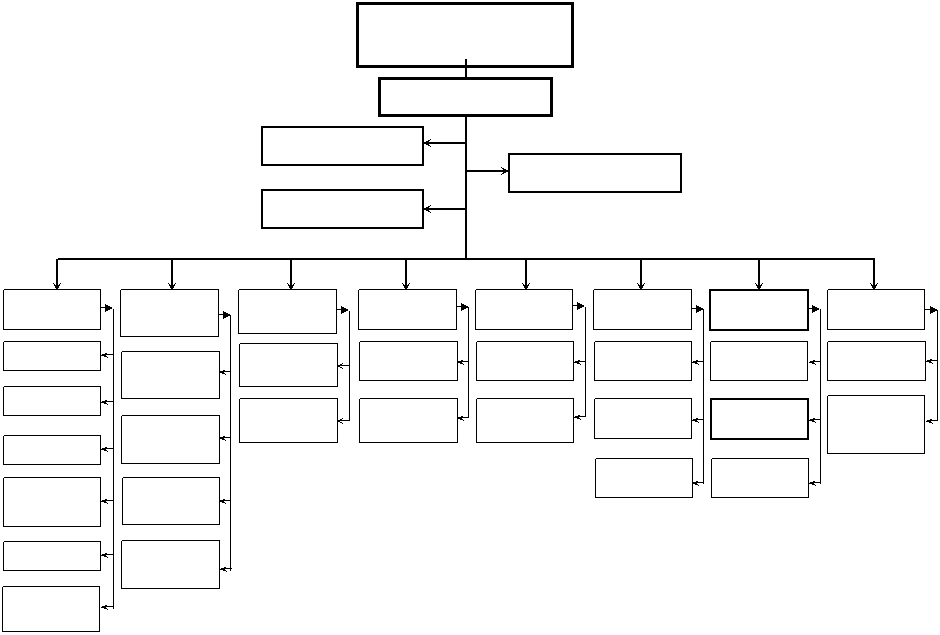
Figure 13
Environmental Management Staff (EMS)
within the Project Management Unit (PMU)

1. The training program will be designed to ensure that appropriate skilled staff are used to operate the power plant at all times. Aspects of occupational health and safety and emergency procedures are described below.
2. In addition to this environmental training for all staff employed at the plant, special environmental training will be given to the staff employed for the EMU. They will receive training in the following:
· day-to-day monitoring activities;
· monitoring the stack emissions;
· collection and analysis of air quality data;
· monitoring the water effluents;
· collection and analysis of water quality information;
· use of monitoring equipment, operation and maintenance;
· industrial hygiene;
· occupational health and safety; and
· emergency and contingency procedures.
Table 14 illustrates the recommended training for the EMS.
9.3 Occupational Health and Safety
3. UEEPC/HPP will establish and integrate policies and procedures on occupational health and safety into the operation of the power plant which meet the requirements of Egyptian and World Bank guidelines as given in Section 2 of the report. The policies and procedures will also be designed to comply with all manufacturers safety data sheets for chemical storage and usage, so as to provide a safe and healthy working environment.
4. Occupational health and safety programs will be supported by staff training for the power plant and the appointment of the Assistant Plant Manager. The training will include, but will not be limited to, the following:
· general area safety;
· specific job safety;
· general electrical safety;
· handling of hazardous materials;
· entry into confined spaces;
· hearing conservation;
· repetitive stress disorders;
· Code of Safe Practices;
· use of personal protective equipment; and
· first-aid.
Table 14
Recommended Training Required for the PMU/EMS
|
Training Course |
Contents |
Type of Training |
Participants |
Proposed Scheduling |
Cost Estimate (L.E.) |
|
General EHS Training: · Induction Training on Appointment · Specialist Training · Refresher Training (as required) |
· General operation of the power plant. · Specific job roles and procedures. · Occupational Health & Safety: - general area safety; - specific job safety; - general electrical safety; - handling of hazardous materials; - entry into confined spaces; - hearing conservation; - repetitive stress disorders; - Code of Safe Practices; - use of personal protective equipment; and - first-aid. · Contingency Plans & Emergency Procedures. |
Classroom and On-job training. |
All power plant staff, including EMS. |
Once before project implementation and during operation for refresher training. |
Included in construction & operation cost. (around US$ 145 k) |
|
Special Environmental Training on Environmental Aspects of Power Generation and Monitoring. |
· Allover Environmental Performance of the P.P. · Day-to-day monitoring activities. · Monitoring the stack emissions. · Collection & analysis of air quality data. · Monitoring the water effluents. · Collection & analysis of water quality information. · Use of monitoring equipment, operation and maintenance. · Industrial Hygiene. |
Classroom and On-job training. |
EMS. (3-4 staff members) |
Once before project implementation and monitoring program. |
Included in construction & operation cost.
(around US$ |
|
Environmental Auditing and Inspection, including periodic safety audits |
· Environmental Auditing Techniques. · Auditing Checklists. · Environmental Auditing Reports. · Safety Audits: - Physical inspections; - Review of plant records; - Interviews with staff. |
Classroom and Field Exercises. |
EMS. |
Once after project implementation |
Included in operation cost.
(around US$ |
|
Social Communications |
· Communications Skills. · Mass Communications. |
Classroom and Field Exercises. |
EMS. |
Once before project implementation and monitoring program. |
Included in construction & operation cost.
(around US$ |
5. The training will include induction courses when staff are first employed at the power plant, with specialist and refresher training as required by the job role. Training will be updated annually and occupational health and safety procedures will be included within the Operations Manual for the power plant.
6. The safety record at the power plant will be reviewed each month at a formal meeting, led by the Assistant Plant Manager, where the agenda items, comments and attendance will be recorded and kept on file.
7. In addition, periodic safety audits will be conducted to verify compliance with safe working practices, which will comprise physical inspections, review of plant records and interviews with staff. The audits will assign responsibility for any corrective action necessary to mitigate a potential hazard and allow the tracking of the completion of the corrective measure.
9.4 Emergency Procedures and Accident Response
8. Instructions on emergency measures necessary to safeguard employees and the wider environment will be prepared as part of the Operations Manual for the power plant.
Accident Response
9. As part of the preparation of emergency procedures and the plans for accident response arrangements, the project company will carry out the following :
· review industry-specific and Egyptian and World Bank standards and regulations;
· establish general guidelines on potential safety and accident risks;
· prepare job-specific operating instructions where appropriate;
· establish safety and security notices for hazardous materials;
· prepare specific emergency operating instructions;
· provide protective equipment (including clothing, air and ear protection etc.) as required;
· evaluate information and feedback from employees; and
· record and investigate all accidents, injuries and incidents.
10. Contingency plans and emergency procedures are being developed to cover events due to operational failures, natural causes and acts of third parties. The plans and procedures will cover, as a minimum, the following:
· fire;
· explosion;
· bomb alerts;
· leaks and spills of hazardous materials;
· structure or equipment failures;
· injuries and illnesses;
· risk from natural disasters (wind, sandstorm, earthquake); and
· third-party risks (potential impacts of an accident occurring at another industrial facility which may impact upon the power plant).
Oil Spill Contingency Plan
11. As Good practice and part of the ESMP, UEEPC/PMU/EMS will prepare an Oil Spill Contingency Plan to be ready for implementation by the start of construction activities.
12. Natural Gas will be delivered to the site by pipelines in a quantity of about 6 Millions m3/day.
13. Light fuel oil will be delivered to the site by road and stored in:
· three 20,000 m3 tanks for the light fuel oil (oil no. 2 / sollar).
14. These tanks are surrounded contained within separate retention area which is designed to contain 110% of one tank.
15. The plan will cover the following activities.
· delivery;
· handling;
· spills; and
· cleanup.
16. The plan will detail procedures, responsibilities, chains of command, information flows, monitoring and documentation. Previouslly illustrated Figure 12 presents institutional arrangements for the Helwan South power project.
10. IMPLEMENTATION SCHEDULE AND REPORTING
17. Environmental and social management and monitoring activities will be implemented (according to the ESMP), following the same project schedule, as all activities are mainstreamed in the project design. Achievements/problems will be reported in the project quarterly progress reports and should be timely addressed by the project management and the Bank.
11. CONCLUSIONS
18. The Project Company proposes to develop a new steam power plant of total capacity 3 x 650 MWe at the area reserved for the Helwan South Power Plant on land owned by the UEEPC Company. The site is a rural Setting and does not contain significant residential environmental sensitivity of importance.
19. The key environmental issues associated with the power plant are as follows:
· Emission of oxides of nitrogen to the air;
· Generation and disposal of liquid effluents including cooling water;
· Emission of noise; and
· Socio-economic impacts.
20. The Environmental and Social Impact Assessment has evaluated the potential environmental impacts during construction and operation of the proposed power plant. In particular, the potential impacts of the flue gas emissions to the air, generation and disposal of liquid effluents including cooling water; and the emissions of noise have been assessed using sophisticated modeling techniques, which include consideration of the ambient background environment and the characteristics of the releases or emissions, and predicts the potential impacts which may occur.
21. The Environmental and Social Impact Assessment has, also, evaluated the potential socio-economic impacts during construction and operation of the proposed power plant.
22. It is anticipated that the power plant will provide a net positive socio-economic impact through the provision of employment opportunities and attraction of economic investment into the area. In addition, the use of local labor (95% during construction), will maximize these positive impacts through the development of the local skill base and will also generate increased demand for local services, materials and products.
23. Land expropriation is not likely for the sub-projects, including interconnecting transmission lines and gas pipeline. However, in order to handle any potential future changes, a Resettlement Policy Framework (RPF) is prepared by ECG separately in a stand alone document to be attached with this ESIA report. Fair compensation, if any, will be paid for the right of way according to the Law 63 of the Year 1974 and the recommendations set out in the RPF. The ESMP will be revised after exact routes for both of the gas connection an transmission lines are available.
24. The assessment indicates that no significant environmental and social impacts will occur as a result of the construction or operation of the power plant and, when taken together, the overall environmental and social impact will not be significant.
12. REFERENCES AND CONTACTS
References and Documents Consulted
1. Egyptian Government (1994): Law 4 for 1994 and its Executive Regulations and their modifying amendment - Law for the Environment.
2. Egyptian Government (2009): Law 9 for 2009 for some amendments to the Law 4/1994..
3. Egyptian Environmental Affairs Agency (1996): Guidelines on Egyptian Environmental Impact Assessment, including 2009 updates.
4. Egyptian Environmental Affairs Agency (1995): Egypt Country Study on Biological Diversity; Publications of the National Biodiversity Unit No. 3.
5. Egyptian Environmental Affairs Agency (1997): Birds known to occur in Egypt; Publications of the National Biodiversity Unit No. 8.
6. Egyptian Environmental Affairs Agency (1997): Freshwater fishes of Egypt; Publications of the National Biodiversity Unit No. 9.
7. Egyptian Environmental Affairs Agency (1999): Freshwater molluscs of Egypt; Publications of the National Biodiversity Unit No. 10.
8. Egyptian Meteorological Authority (1996): Climatic Atlas of Egypt; Cairo.
9. Geological Map of Egypt (1981): Scale 1:2,000000. Geological Survey of Egypt (EGSMA) Cairo.
10. Arab Republic of Egypt, General Agency for Public Mobilization and Statistics (December 2009): The Statistical Year Book.
11. Kebeasy, R. M. (1990): Seismicity in the Geology of Egypt. R. Said (ed) Balkeme. 51-59.
12. Montz, B. E., Gruntfest, E., (2002): Flash flood mitigation; Recommendations for research and applications, Environmental Hazards. 4, 15-22
13. Google Earth Pro. http://www.earth.google.com/
14. Water Research Center, Research Institute for Groundwater (RIGW), Minishy of Public Works and Water Resources (1992): Hydrogeological Map of Egypt.
15. Kebeasy, R. M. (1990): Seismicity. in: The Geology of Egypt, R. Said (ed.); Balkema, p. 51-59.
16. Boulos L (1995): Flora of Egypt (Checklist).
17. UNEP/WHO (1999a): Draft Country Reports on Pollution Hot Spots and Sensitive Areas; Country Report for Egypt.
18. Anderson , J. R. ; Hardy, E. T. ; Roach, J. T. and Witmer, R. E. (1976): A Land-use and Land-cover Classification System for use with Remote Sensor Data. U. S. Geological Survey Professional Paper 964.
19. El Araby, H., and Sultan, M. (2000): Integrated seismic risk map of Egypt, Seismological Research Letters, v. 71, p. 52-65.
20. Hammad, F. A. (1980): Geomorphological and hydrogeological aspects of Upper Egypt (A.R.E.), Annals Geol. Surv of Egypt Vol. XI, pp. 650-670.
21.
Morency, R E., J,
(1998): The Hydrology of the South Delta ,Egypt
in: Groundwater Potential of the Delta, Egypt, Edited by F. El-Baz et al.,
Ministry Agriculture and Land Reclamation, Cairo, Egypt.
22. World Bank Group (1991): Operational Directive 4.01: Environmental Assessment.
23. World Bank Group (1994): Environment, Health and Safety Guidelines: Thermal Power Plants.
24. World Bank Group (1998): Thermal Power – Guidelines for New Plants in Pollution Prevention and Abatement Handbook - Part III.
25. World Health Organization (WHO) (1971): International Standards for Drinking Water; 3rd Edition, Geneva, Switzerland.
26. UNESCO (1979): Predicting Effects of Power Plant Once-through Cooling on Aquatic Systems; Paris.
27. US-EPA (1986): Guidance on Air Quality Models (Revised).
28. UK Department of Transport et al. (1993): Design Manual for Roads and Highways.
29. UK Institute of Environmental Assessment (1993): Guidelines for the Environmental Assessment of Road Traffic; Guidance Notes No. l, IEA.
30. Institute of Highways and Transportation (1994): Traffic Impact Assessment. IHT.
31. General Authority for Roads and Bridge and Land Transport (2007): Traffic Report 2007.
32. The Egyptian Code of Practice for Rural and Urban Roads, 1998.
33. R. K. Jai; L. V. Urban; G. S. Stacy & H. E. Balbach (1993): Environmental Assessment; Mc Graw-Hill, Inc., New York
34. M. M. El-Wakil (1985): Powerplant Technology; McGraw-Hill Book Company, New York.
35. Azza Hassan, General Director of Information Center, Helwan Governorate (2010): Data on the Helwan Zone, including Atfieh & Kureimat; Information and Decision Support Center, Headquarter, Helwan Governorate.
36. Commercial Services Corporation (CSC) (November 2010): Physical Environmental Setting of the Planned Site of Helwan South Power Plant.
37. Prof. Dr. Kamal T. Hindy and Others (October 2010): Study of Air Quality in Selected Points at an Area for Construction of a Power Plant at Helwan South; National Research Center, State Ministry of Scientific Research.
38. Prof. Dr. Kamal T. Hindy and Others (November 2010): Study of Solid Air Pollutants in Selected Points at the Helwan South Power Plant Site; National Research Center, State Ministry of Scientific Research.
39. MB Consultant (October 2010): Noise Prediction for Helwan South 3x650 MWe Power Project; Ain Shams University, Faculty of Engineering.
40. Prof. Dr. Ibrahim Mabrouk Ibrahim (November 2010): Helwan South Power Plant Traffic Impact Study, Final Report; Faculty of Engineering, Al-Azhar University.
41. Dr. Mahmoud Hussein (November 2010): Proposed Helwan South Power Plant Project: Land-use & Ecological Baseline and Impact Assessment (Terrestrial Ecology) Study; National Authority for Remote Sensing and Space Sciences (NARSS), Ministry of High education, Scientific Research & Technology.
42. Dr. Mahmoud Hussein (November 2010): Aquatic Ecological Baseline and Impact Assessment Study for the Helwan South Power Station; National Authority for Remote Sensing and Space Sciences (NARSS), Ministry of High Education, Scientific Research & Technology.
43. Prof. Dr. Anwar El-Dib and Prof. Dr. Ahmed Morsy (November 2010): Assessment of Water Quality Along Selected Sites for the Construction of Electric Generation Station at Helwan South, National Research Center.
44. Dr. Fathi El-Gamal, Dr. Khaled Abdel Hai, Dr. Ahmed M. Amin, Eng. Fahmy S. Abdel-Haleem (November 2010); Helwan South Power Project – Bathymetric and Hydrographic Survey, Hydraulic Research Institute.
45. Dr. Fathi El-Gamal, Dr. Khaled Abdel Hai, Dr. Ahmed M. Amin, Eng. Fahmy S. Abdel-Haleem (February 2011); Helwan South Power Project – Mathematical Modeling study for Intake and Outfall Structures, Final Report.
46. Engineering Consultants Group (ECG) (December 2010): Air Quality Dispersion Modeling Study for the Helwan South Power Project.
47. Engineering Consultants Group (ECG) (December 2010): Socio-economic Baseline and Impact Study for the Helwan South Steam Power Project.
48. Power Generation Engineering and Services Company (PGESCo) (December 2010): New Suez 650 MWe Steam Power Plant Project, Environmental Impact Assessment.
49. Engineering Consultants Group (ECG) (August 2008):, El-Ain Al-Sokhna 3x650 MWe Steam Power Plant Project, Environmental Impact Assessment.
Contacts
25. Key persons contacted for comments or further information include the following:
· Chairman of the EEHC: Dr. Mohamed Awad
· Executive Board Member for Planning, Research and Affairs of
Service Companies: Dr. Kamel Yassin
· Chairman of UEEPC: Eng. Abdel-Mohsen Abdel-Ghaffar Abdel-Hadi
· Counsellor for Environmental Management and Studies;
EEHC: Eng. Maher Aziz Bedrous
· Project Manager of ECG: Eng. Hassan El-Banna
Annex I
CHANCE FIND PROCEDURES
Chance find procedures will be used as follows:
(a) Stop the construction activities in the area of the chance find;
(b) Delineate the discovered site or area;
(c) Secure the site to prevent any damage or loss of removable objects. In cases of removable antiquities or sensitive remains, a night guard shall be present until the responsible local authorities and the equivalent take over;
(d) Notify the supervisory Engineer who in turn will notify the responsible local authorities and the General Authority of Antiquities immediately (within 24 hours or less);
(e) Responsible local authorities and the General Authority of Antiquities would be in charge of protecting and preserving the site before deciding on subsequent appropriate procedures. This would require a preliminary evaluation of the findings to be performed by the archeologists of the General Authority of Antiquities (within 72 hours). The significance and importance of the findings should be assessed according to the various criteria relevant to cultural heritage; those include the aesthetic, historic, scientific or research, social and economic values;
(f) Decisions on how to handle the finding shall be taken by the responsible authorities and the General Authority of Antiquities. This could include changes in the layout (such as when finding an irremovable remain of cultural or archeological importance) conservation, preservation, restoration and salvage;
(g) Implementation for the authority decision concerning the management of the finding shall be communicated in writing by the General Authority of Antiquities; and
(h) Construction work could resume only after permission is given from the responsible local authorities and the General Authority of Antiquities concerning safeguard of the heritage.
These procedures must be referred to as standard provisions in construction contracts, when applicable, During project supervision, the Site Engineer shall monitor the above regulations relating to the treatment of any chance find encountered are observed.
Annex II
LIST OF EIA AND SOCIAL ASSESSMENT TEAM MEMBERS
|
Position |
Name |
|
ECG |
|
|
Project Manager |
Eng. Hassan El-Banna |
|
Atmospheric Dispersion Modeling Specialist |
ECG Air Quality Dept. |
|
Socio-economic Specialist |
ECG Socio-economic Studies Dept. |
|
Solid & Hazardous Waste Management Specialist |
ECG Waste Management Dept. |
|
Ecologist |
Dr. Mahmoud Hussein |
|
Air Quality Measurements |
National Research Center |
|
Water Quality Measurements |
National Research Center |
|
Al-Azhar University, Faculty of Engineering |
Dr. Ibrahim Mabrouk and the team |
|
|
|
|
MB. Consultant |
Consulting team of the Firm |
|
|
|
|
CSC Consulting Firm |
Geological Special team |
|
|
|
|
EcoConServe |
Quantitative Risk Assessment team |
|
Hydraulics Research Institute |
Prof. Dr. Fathi El-Gamal, Prof. Dr. Khalid Abdel-Hai Ramadan and the team |
|
|
|
|
EEHC Supervisor |
|
|
Counsellor for Environment Management and Studies Sector |
Eng. Maher Aziz Bedrous |